Mapping the World of Art: Part X — The Open Map
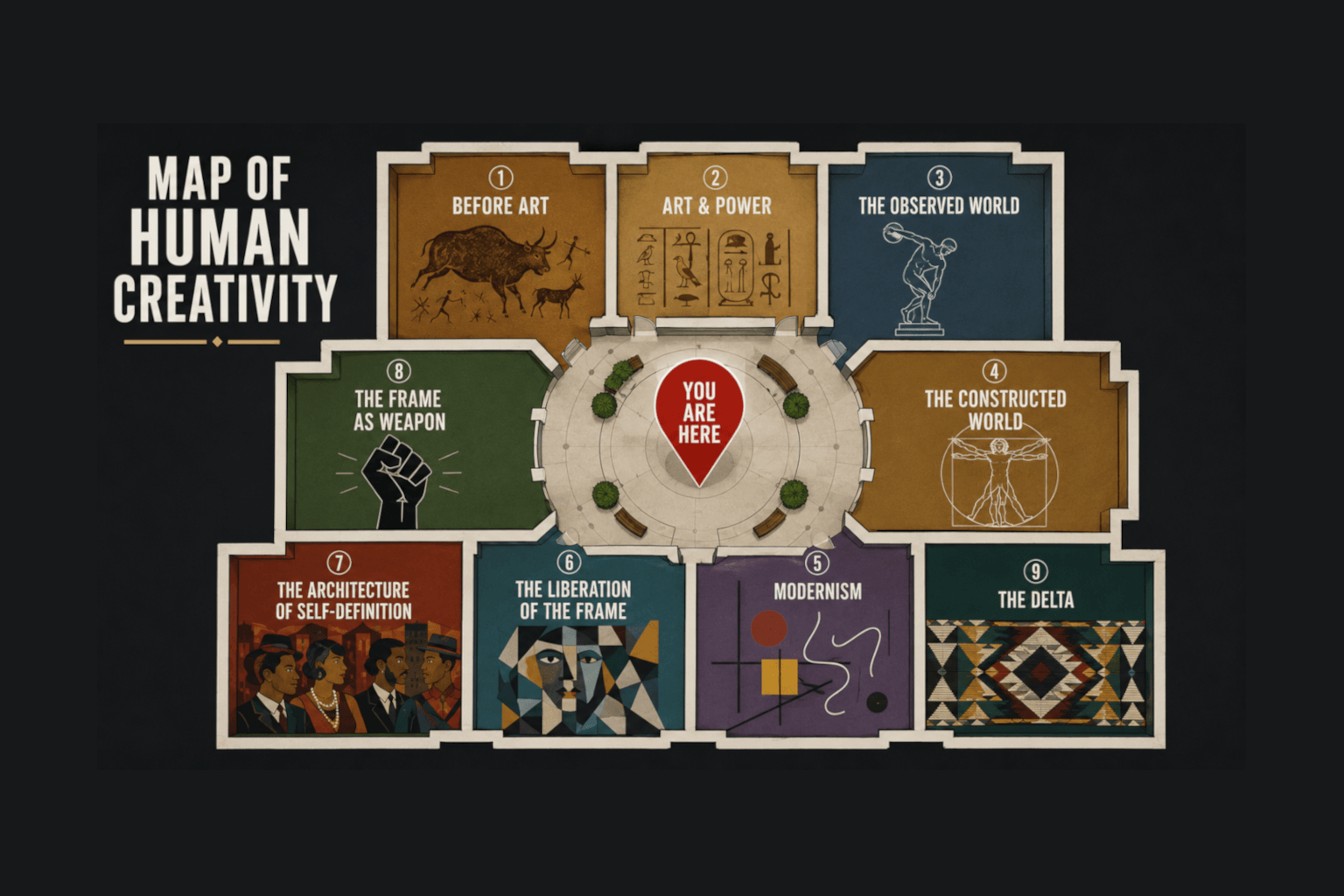
The Open Map — A conceptual museum floor plan tracing the journey through Mapping the World of Art. Centered on a bold "YOU ARE HERE" marker, it reminds us that art history is not just a record of the past, but a map for navigating the present and future.
← Part IX — The Frame as Weapon
When we began this journey ten installments ago, we stood at the door of a hoarder's house. That house was a world without art history—a suffocating wall of visual noise where gilded Renaissance frames were piled on top of Egyptian reliefs, Greek torsos intertwined with Impressionist canvases, and the Baroque period was stuffed in drawers alongside the Harlem Renaissance. Nothing made sense because nothing had a place, and without a map, you were left standing at the edge looking in.
Over these ten posts, we have seen how art history transforms our ability to travel the vast geography of human creativity. Art history sorted the clutter, built the shelves, and gave every movement a place.
But we have also learned that art history doesn't end with organization. Clearing the room is not the final destination—it is a building permit. It gives us the foundation and authority we need to knock down artificial walls, construct new corridors of thought, and build entirely new halls of reverence.
The Landscape We Built
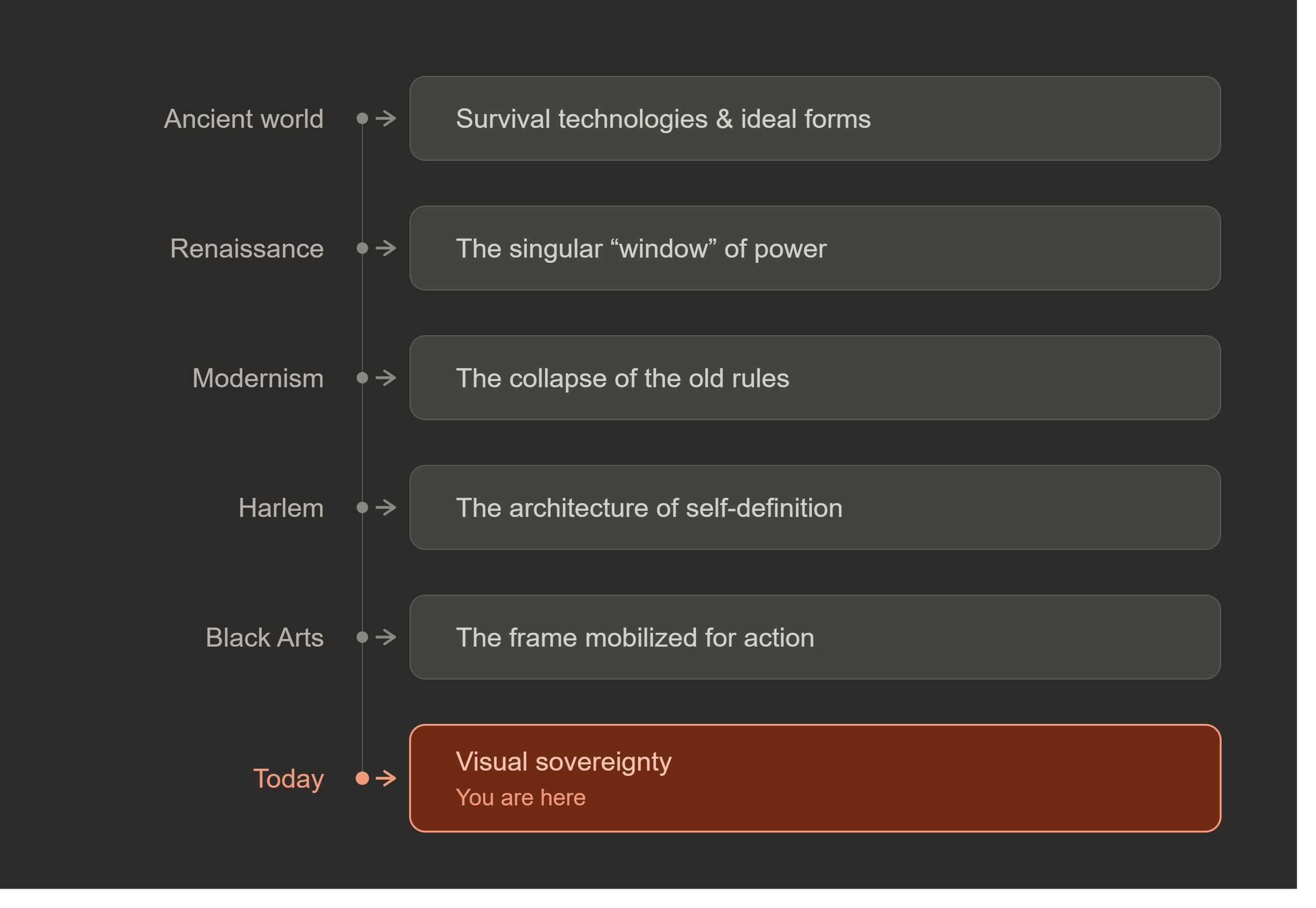
What once felt like a random collection of eras is now visible as a continuous struggle over who gets to define reality.
Humanity started in prehistoric caves using images simply to survive. In Egypt, artists built rigid grids to formalize cosmic order. That stability freed Greece to chase the ideal of human perfection, which the Renaissance later expanded into an imperial window designed to control how the world was seen.
When those old windows finally shattered under the weight of modernism, the ground was cleared for something revolutionary. In Harlem, Black artists stepped into that open space to rebuild their own history—a foundation that the Black Arts Movement then carried directly into the streets as an active tool for liberation.
Seen one by one, these might look like separate history lessons. But step back, and the true picture emerges: an unbroken story of human beings using creativity to claim their power.
Because of that story, Neoclassicism is no longer an unfamiliar label, but an eighteenth-century attempt to restore order through ancient authority. To mention Impressionism, Cubism, or the Harlem Renaissance is no longer to recite isolated movements, but to understand how each grew out of the one before it, challenged what came before, and helped shape what followed.
This is not trivia to memorize for a test. These are landmarks on a map you now know how to read.
Art History Is Not About "Styles"
One of the great limitations of the way art history is often taught is the assumption that it is primarily a catalog of decorative styles. Labels matter, but they are not the destination. They are merely road signs.
The real journey has always been about how human beings choose to see the world. Every culture across human history has used visual tools to answer the exact same fundamental questions:
Who gets to define reality? Whose stories are sacred, and whose are erased?
When you look at art, you are looking at humanity's ongoing conversation about who gets to shape the human experience.
That is why the Northeast Louisiana Delta African-American Heritage Museum stands on this map. We are a physical coordinate where our history is preserved, expanded, and declared—reminding us that the Delta has helped shape art history and the modern world far beyond our own geography.
Visual Sovereignty
Throughout this series, you have learned far more than the vocabulary of art. You have seen how visual systems are engineered. You have learned how frames are built to persuade, how perspective can be used to exclude, and how imagery can be reclaimed to liberate.
That knowledge offers something far more valuable than mere visual literacy.
It offers Visual Sovereignty—the freedom to understand inherited ways of seeing, question them, and consciously claim your own. It is the confidence to walk into any museum, stand before any monument, or analyze any image, decode the hidden rules of the frame, and engage it with confidence rather than simply accepting someone else's point of view.
Visual sovereignty cannot be handed to you. No institution can impose it upon you.
It is something you claim for yourself.
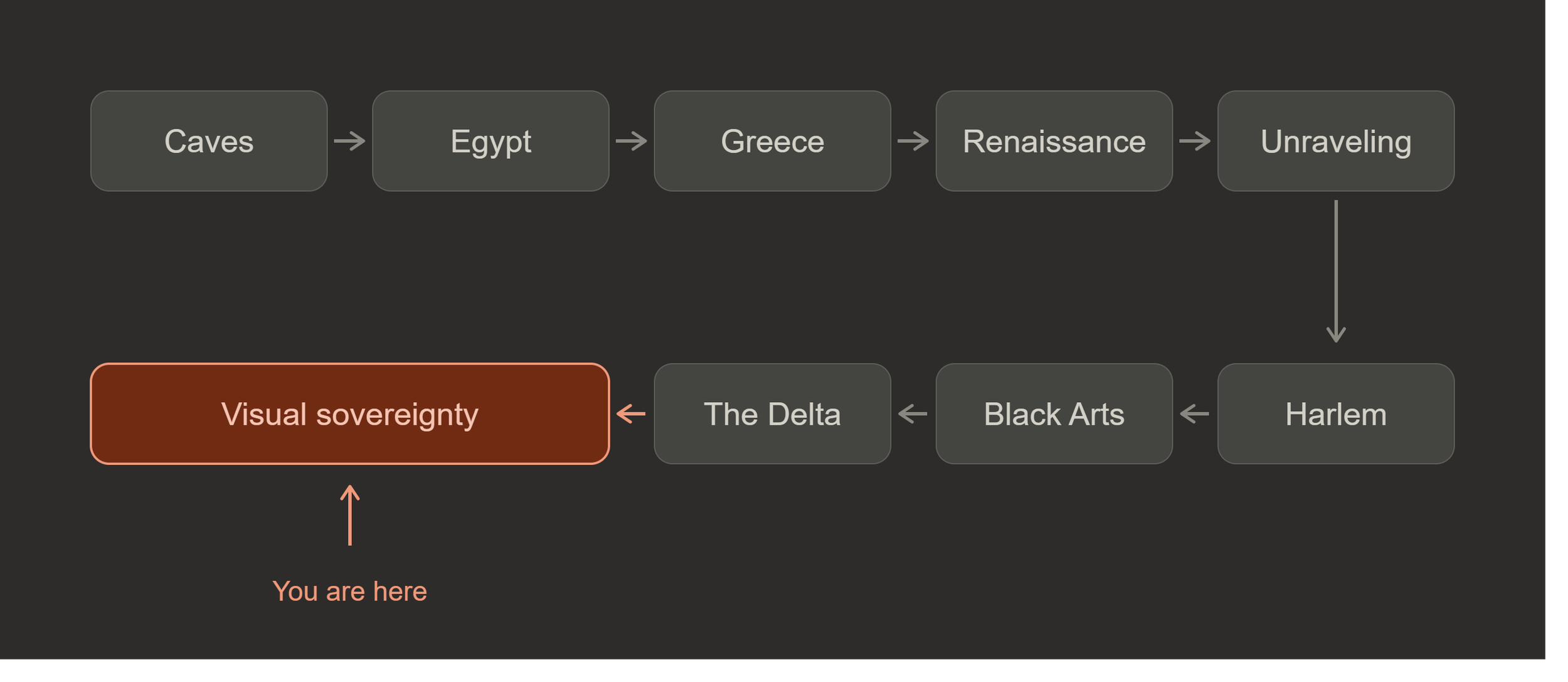
THE OPEN MAP
The caves. Egypt. Greece. The Renaissance. Modernism. Harlem. The Black Arts Movement. The Delta.
These are no longer the jumbled mess in a hoarder's house. They are roads you understand how to connect. You understand why the old Renaissance window had to break. You understand how a people used fragments to build a new world.
You now possess what this series set out to give you: a clear sense of where you stand within the vast landscape of art history, and the confidence to navigate wherever your curiosity leads next.
Every generation inherits a landscape shaped by those who came before it. Every generation also redraws that landscape.
The question is no longer whether you are part of art history. You are.
The question is: What will you build on the territory you have reclaimed?
Thank you for walking the map with us.
The journey through art history ends here. The journey of seeing begins now.
Mapping the World of Art:
You are at the end of the map.