Are You Making Art Right Now Without Knowing It?
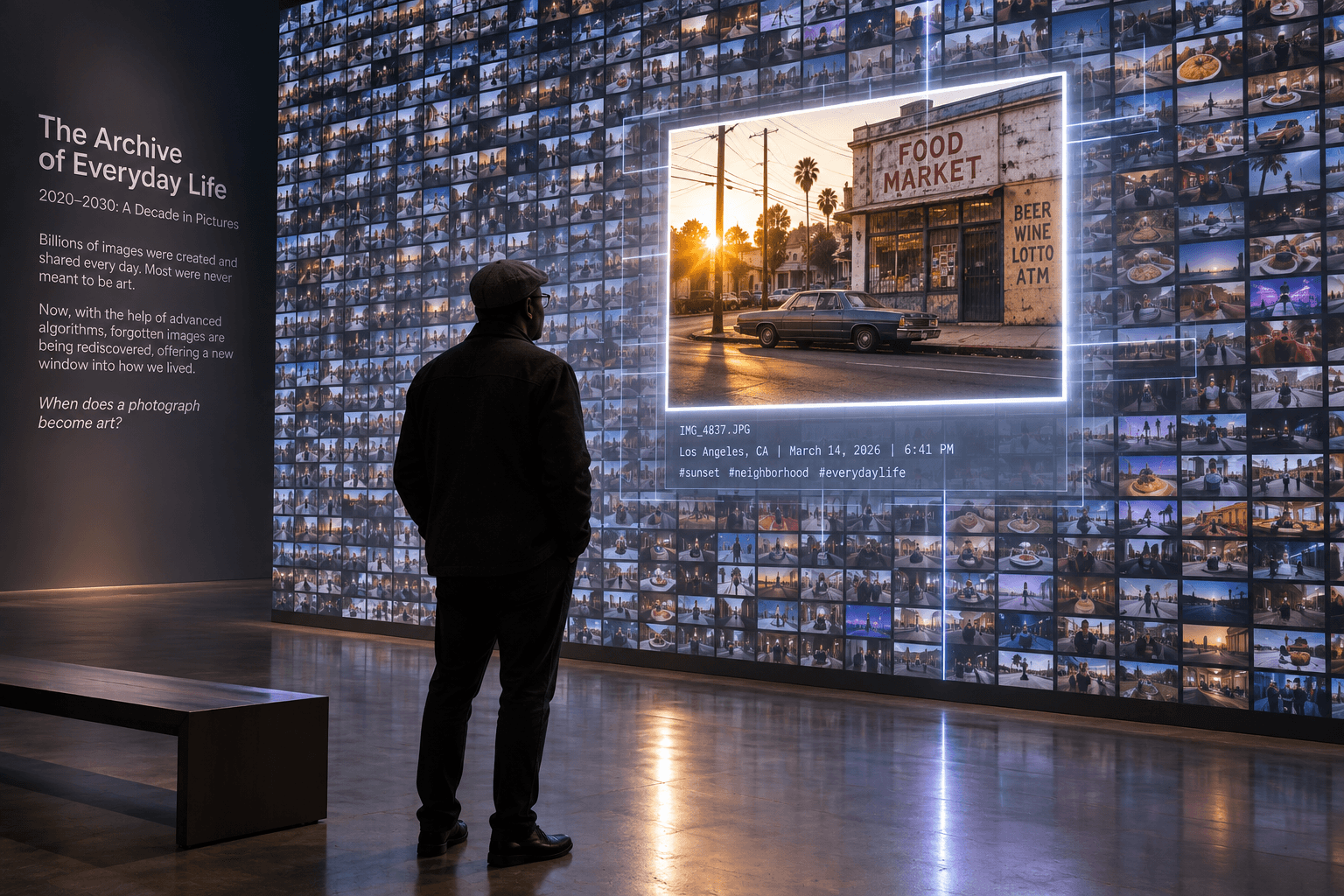
When does an ordinary photograph become art? A familiar street scene takes on a different meaning when it moves from a phone or archive to a museum wall. Credit: AI-generated image created for the Northeast Louisiana Delta African-American Heritage Museum.
In a museum archive somewhere sits a box of photographs that were never meant to be art. An architect took them while researching buildings—storefronts, houses, street corners, details of construction that caught his eye. They were working documents, visual notes, taken by the hundreds over a career. Nobody thought much at the time about what else was being recorded: the automobile parked at the curb, the hand-painted sign over the grocery store, the neighbors standing on the sidewalk.
Then fifty years pass. The buildings come down, the businesses close, the neighborhood becomes something else entirely. And those mundane working photographs now contain something the photographer could never have put there on purpose: time.
A museum acquires the collection. A curator selects a group of images, mounts them, lights them, hangs them on a gallery wall. People stand in front of them in silence. The physical object has not changed by a single grain. Everything about how we experience it has.
Which raises a question artists, philosophers, critics, and historians have been circling for centuries: Who decides when something becomes art?
Who Decides?
Art has never settled this. We have argued about it for centuries, and nearly every tidy definition eventually runs into an object that refuses to cooperate. Art is something made by an artist—but that only moves the problem back a step: who qualifies as an artist?
Art requires artistic intention—but there stands the architect, insisting his photographs were site research. Institutions don't rescue us either: museums have ignored entire bodies of work that later generations called masterworks, and the market routinely mistakes price for value. So where does the authority actually sit? With the maker, the curator, the board, the market, or the long arc of history?
We may have been looking in the wrong place by fixing on the point of origin. What if art doesn't belong exclusively to the person who made the object, but to the ecosystem that surrounds it long after it leaves their hands?
What About the Person Looking?
Return to the architect's photographs. The photographer insists they aren't art. The curator disagrees and hangs them anyway. A critic writes a sharp essay about their composition. Yet none of those authorities can make you experience the photographs as art when you are standing in front of them.
Something still has to happen in the quiet space between the object and a single human eye. Art may not be an intrinsic property sealed inside an object like a chemical element. Art may be an event—the spark that happens between object and viewer in the act of looking.
The Encounter Across Time
Test it in both directions. An artist completes a magnificent painting, seals it in an opaque box, and buries it where no eye will ever find it. The artist calls it art. Is that private intention enough?
Now reverse it. Someone takes a photograph with no artistic intention at all—a quick light check, a functional note. Decades later another person finds it and sees composition, quiet beauty, sadness, historical depth. The maker says it isn't art. The viewer says it is.
The question stops being academic the moment you look at what we do with our phones. We may be living through an era with more accidental artists than any point in human history, and no idea which of them posterity will care about.
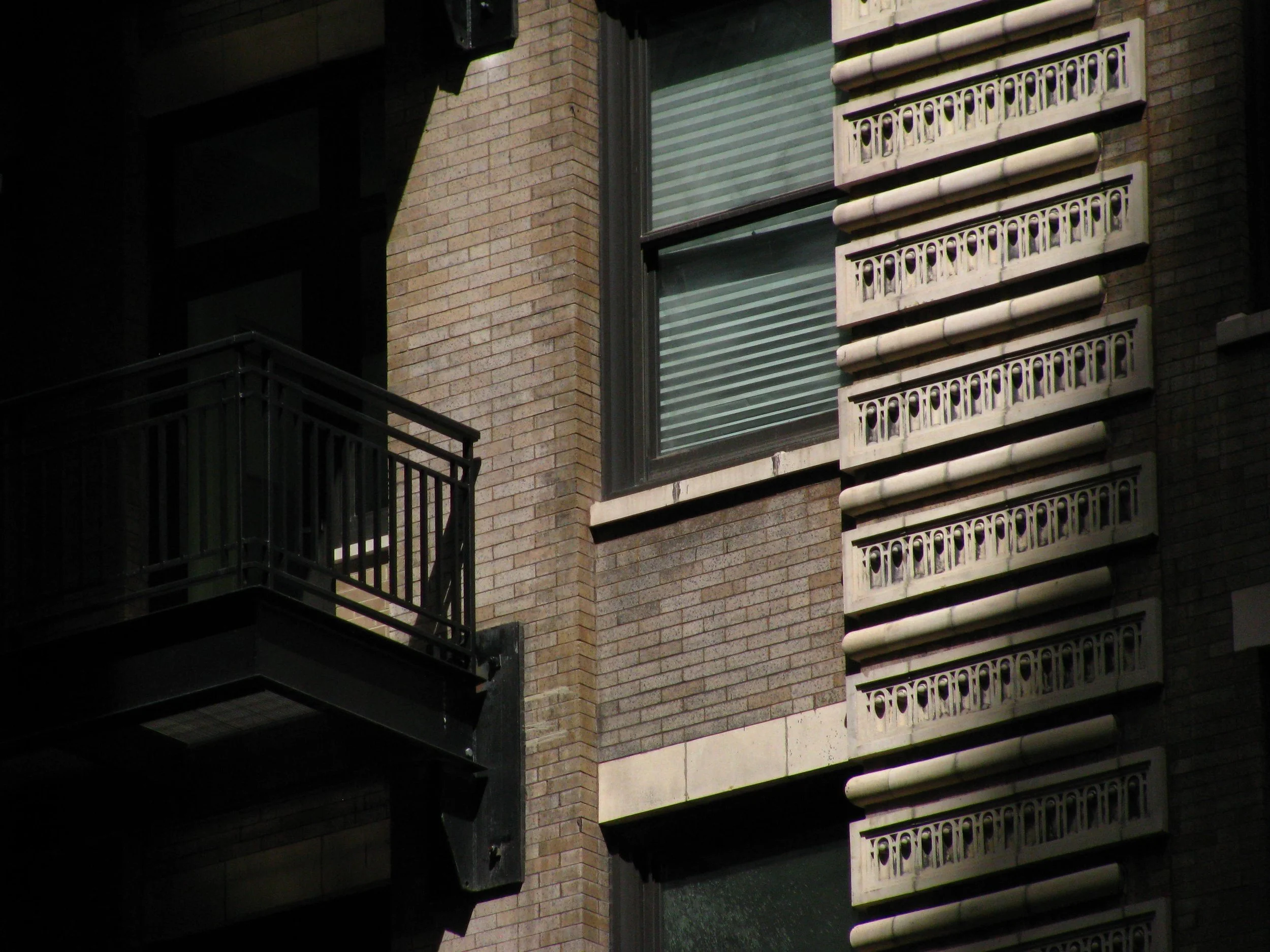
Apartment Building in the Afternoon Sunlight — An ordinary Chicago street scene photographed while walking through the city in 2009. What may begin as a casual photograph can become something very different as time changes the world within its frame. Credit: Photo by Alex Ford, 2009, via Wikimedia Commons. Licensed under Creative Commons Attribution 2.0 (CC BY 2.0).
The Largest Accidental Art Movement in History?
Billions of images are made and uploaded every day. Someone photographs a meal, takes a bedroom selfie, snaps a neighborhood storefront, catches the afternoon light on an apartment building because they liked the way it looked. They post it, scroll past, and forget it exists.
Consider what they actually did in that second. They chose a subject, framed the scene, decided what belonged inside the borders, waited for a moment, adjusted the color. These are many of the same formal decisions photographers and painters have been making for centuries.
The difference is that most people making them today don't call themselves artists. And history hasn't had its say yet.
Imagine 2126
Picture a curator a hundred years from now trying to reconstruct ordinary life in 2026. What would they go looking for? Not only the formal photographs we currently deem significant.
They would want the casual shot of a diner that closed in 2031, the background of a selfie that preserved the interior of a demolished apartment, the post showing what people actually wore on a rainy Tuesday. The ordinary photograph becomes extraordinary because the ordinary world it captured no longer exists. Our problem is the inverse of the twentieth-century archivist's: previous generations left behind thousands of physical artifacts; we are leaving behind billions of digital traces.
The curator of 2126 won't be hunting for rare images; they will be drowning in them. They will almost certainly lean on machines to scan the archive, recognize lost locations, and pull obscure images out of the dark. What happens when the archive is so vast that an algorithm decides which image is brought back to human attention?
And what happens when AI doesn't merely select the image, but generates it? If traditional ideas of authorship become difficult to locate, the question of who decides whether the resulting image is art becomes even harder to answer. Yet it arrives at the exact same threshold. The machine can generate or surface the image, but it cannot complete the experience.
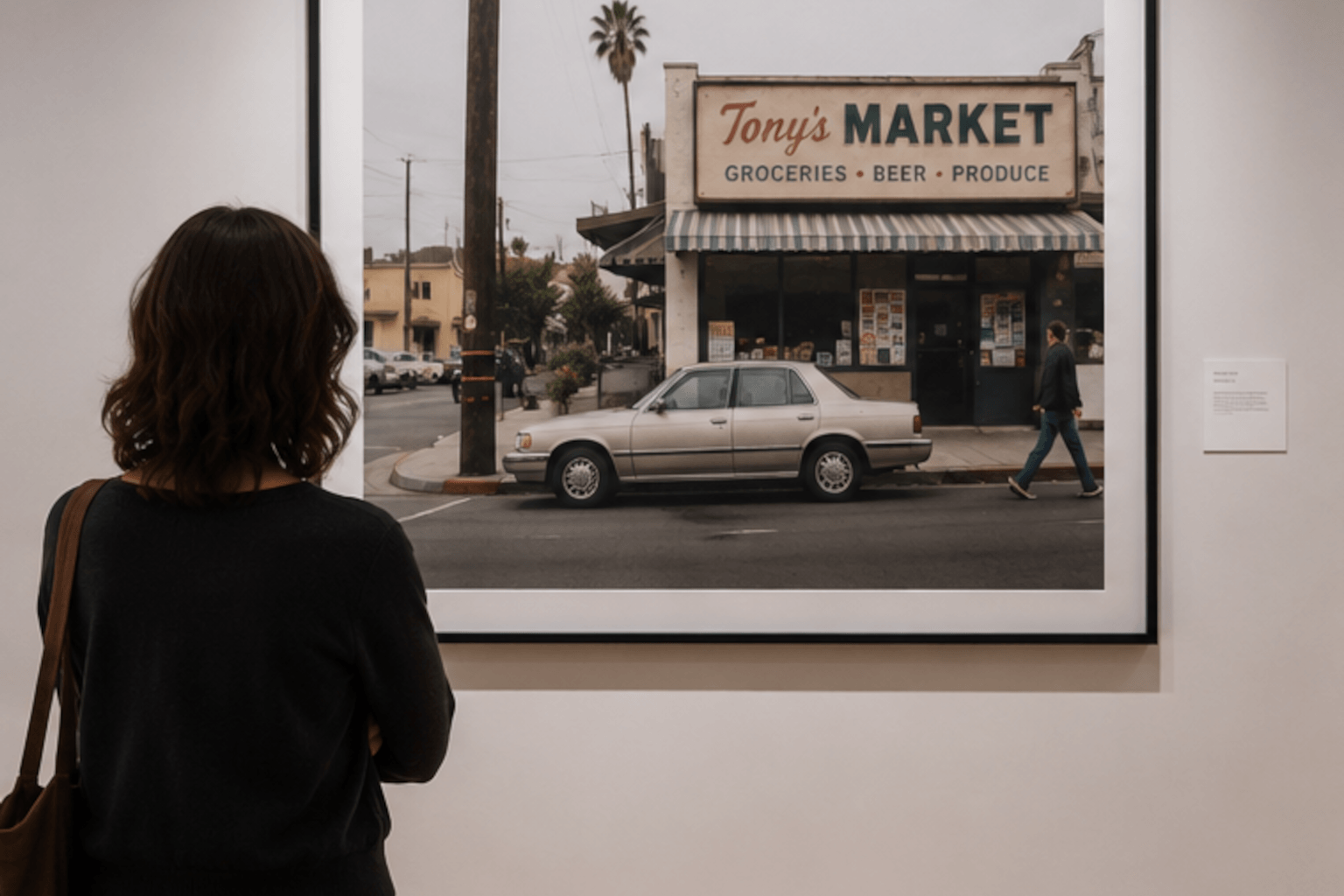
When does a photograph become art? An ordinary neighborhood scene takes on a different presence when framed, illuminated, and encountered on a museum wall. Credit: AI-generated image created for the Northeast Louisiana Delta African-American Heritage Museum.
The Viewer May Be the Constant
The answer to who decides what art is has never belonged exclusively to artists, museums, critics, or markets. The viewer may be the one constant across the entire history of the question. That doesn't mean anything becomes art simply because someone declares it so.
It doesn't mean craft, context, and intention stop mattering—they matter enormously. It means art requires an encounter to complete itself. A cave painting needs an eye to find the animal in the pigment. An altarpiece needs someone to stand before it. A photograph needs someone willing to stop scrolling. An AI-generated image arrives at the same destination.
The maker changes. The object changes. The technology changes. The encounter remains.
Are You Making Art Right Now Without Knowing It?
Quite possibly. Somewhere on your phone is a photograph you took without thinking about it—an image that feels entirely unimportant today. You can't predict who might look at it a century from now, what will have disappeared, or what vanished world someone might recognize inside its frame.
You can't know whether they will call what you made documentation, history, evidence—or art. What we make doesn't stay ours. Sooner or later, everything leaves our hands and enters someone else's field of vision.
The answer has been standing on the other side of the frame all along.