The Inhabited Studio: Confronting the Spirits Making Art
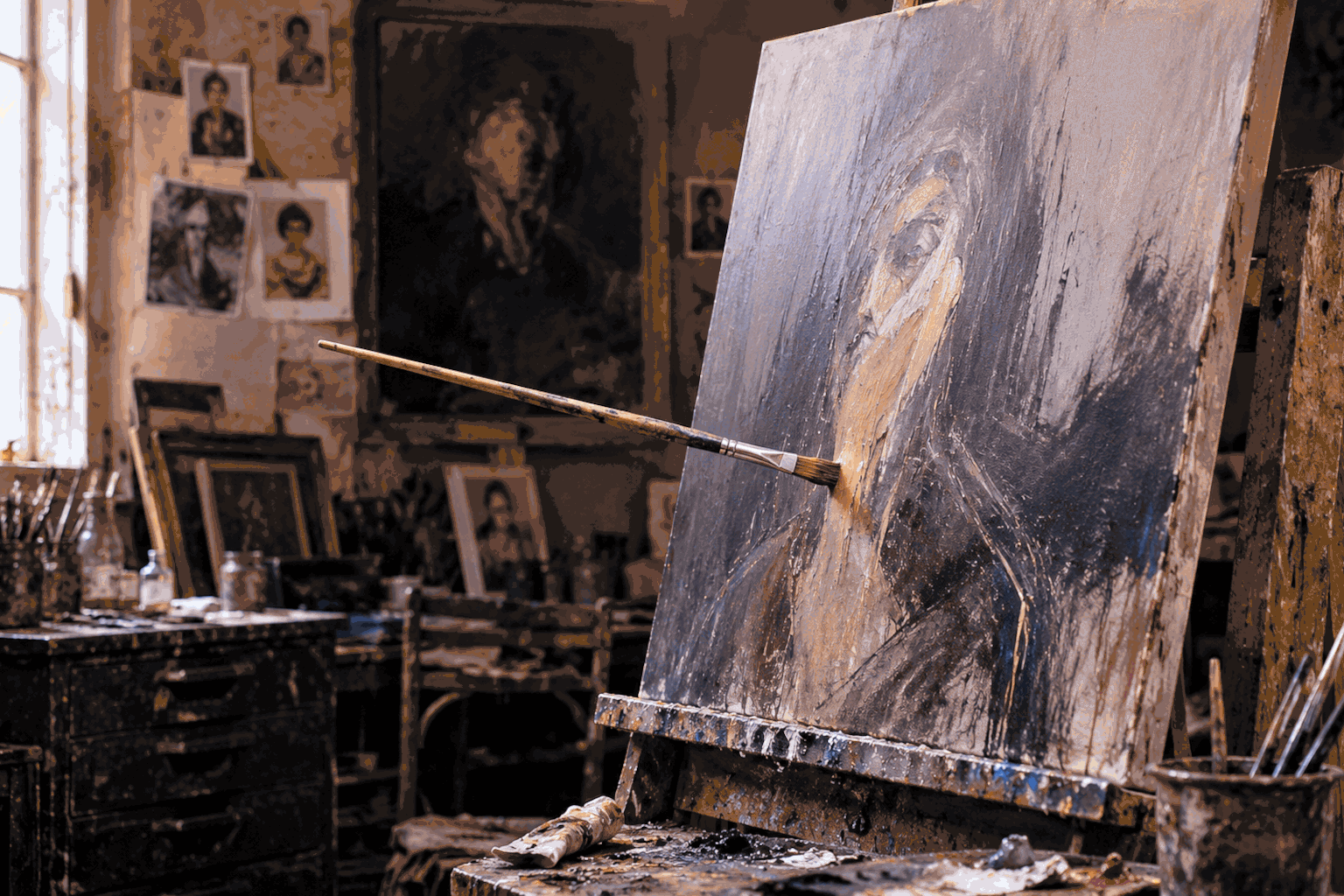
An artist’s brush meets the canvas—with no artist in sight. Credit: AI-generated image.
What if the force behind artistic inspiration does not originate entirely inside the conscious mind of the artist? What if the artistic “genius” is itself a relatively modern idea?
The ancient Greeks, for example, had no exact equivalent. They spoke instead of daimones—spiritual beings or intermediaries understood to occupy a realm between gods and mortals. Plato described poetic inspiration as a condition in which the poet could be aided, even overtaken, by divine influence. Socrates famously spoke of his daimonion, a divine sign or voice that restrained him at decisive moments.
In ancient Rome, another concept developed: the genius. It was not something a person was, but a spirit associated with a person, family, community, or place. That distinction is important. The ancient world possessed a vocabulary for creative power that could exceed the boundaries of ordinary conscious intention. The creator was not necessarily the sole originator of what emerged. Sometimes, the creator was also the recipient.
From Spirit to Grace
Christianity profoundly altered this spiritual landscape. The old pagan categories of gods, spirits, daimones, and intermediary beings could not simply be absorbed unchanged into Christian theology. Over centuries, they were variously reinterpreted, rejected, or associated with demonic forces. Christian thought developed its own vocabulary: Divine Grace, revelation, and the movement of the Holy Spirit.
And so the mechanism changed, but the underlying question did not: Where does extraordinary creative ability come from?
In Medieval and Renaissance Europe, multiple answers surfaced, sometimes simultaneously. Human ability could be understood as natural talent, cultivated skill, intellectual power, divine gift, or some combination of them. Renaissance humanism increasingly elevated the status of the individual artist, and eventually the extraordinary creator began to occupy a cultural position quite different from that of the anonymous medieval craftsman.
An extraordinary example of this transformation was Michelangelo. His contemporaries called him Il Divino—“The Divine One.” The title did not mean that Michelangelo was literally considered a god, but it expressed the almost superhuman creative power his contemporaries perceived in his work.
Michelangelo embodied something significant that was happening. The genius was gradually becoming the person. What had once named a spirit associated with the person was gradually becoming a quality attributed to the person. They are the genius. The genius is them. It had become something that defined the individual, and that shift would eventually become so complete that today it is barely noticed. We routinely say someone is a genius. The mysterious source had been relocated inside the person.
The Modern Interior
Modern psychology and neuroscience moved the discussion further inward, investigating creativity through attention, memory, subconscious processing, associative thought, altered states of awareness, improvisation, and deeply absorbed states commonly described as flow.
These approaches have given us enormously valuable ways of studying creativity. They also caution against treating every surprising thought or unusual studio occurrence as evidence of supernatural intervention. The human mind performs extraordinary amounts of processing outside conscious awareness, so an answer can appear before a person is consciously aware of having worked out the problem. A painter can make a decision before being able to articulate why it is right. A writer can encounter a sentence that seems to have arrived fully formed.
Such experiences may originate below the threshold of conscious awareness. But describing a mechanism and describing an experience are not necessarily the same thing.
Artists continue to say that ideas come to them, that the work takes over, that they lose themselves in it, that something happens through them which they do not experience as ordinary deliberate thought. The vocabulary changes, but the sensation remains strangely familiar.
The experience itself has proved remarkably persistent.
The Esoteric Countercurrent
Not every modern artist accepted the migration of creative agency entirely into the individual psyche.
At the beginning of the twentieth century, Hilma af Klint developed a radically abstract visual language while deeply involved in Spiritualism, Theosophy, and other esoteric traditions. Beginning in the 1890s, she met regularly with four other women in a group called The Five. They held séances, practiced automatic writing and drawing, and believed themselves to be communicating with spiritual entities.
In 1906, af Klint believed she had received a commission from a spiritual guide named Amaliel to undertake the enormous cycle that became The Paintings for the Temple. She described some of the early works as being painted directly through her, without preliminary drawings and without knowing beforehand what the paintings were supposed to depict.
But even here, the question of agency is more complicated than the familiar image of an artist becoming a helpless puppet. Af Klint also wrote that she was not expected to "blindly obey" the spiritual beings she believed accompanied her. Later in the project, she described receiving and interpreting messages rather than functioning simply as an instrument through which they acted.
That distinction returns us to the problem at the center of creativity itself. If inspiration feels as though it arrives from somewhere beyond conscious intention, what happens next? Who chooses? Who edits? Who decides that this line remains and that one disappears? Where does surrender end and authorship begin?
The Contemporary Paradox
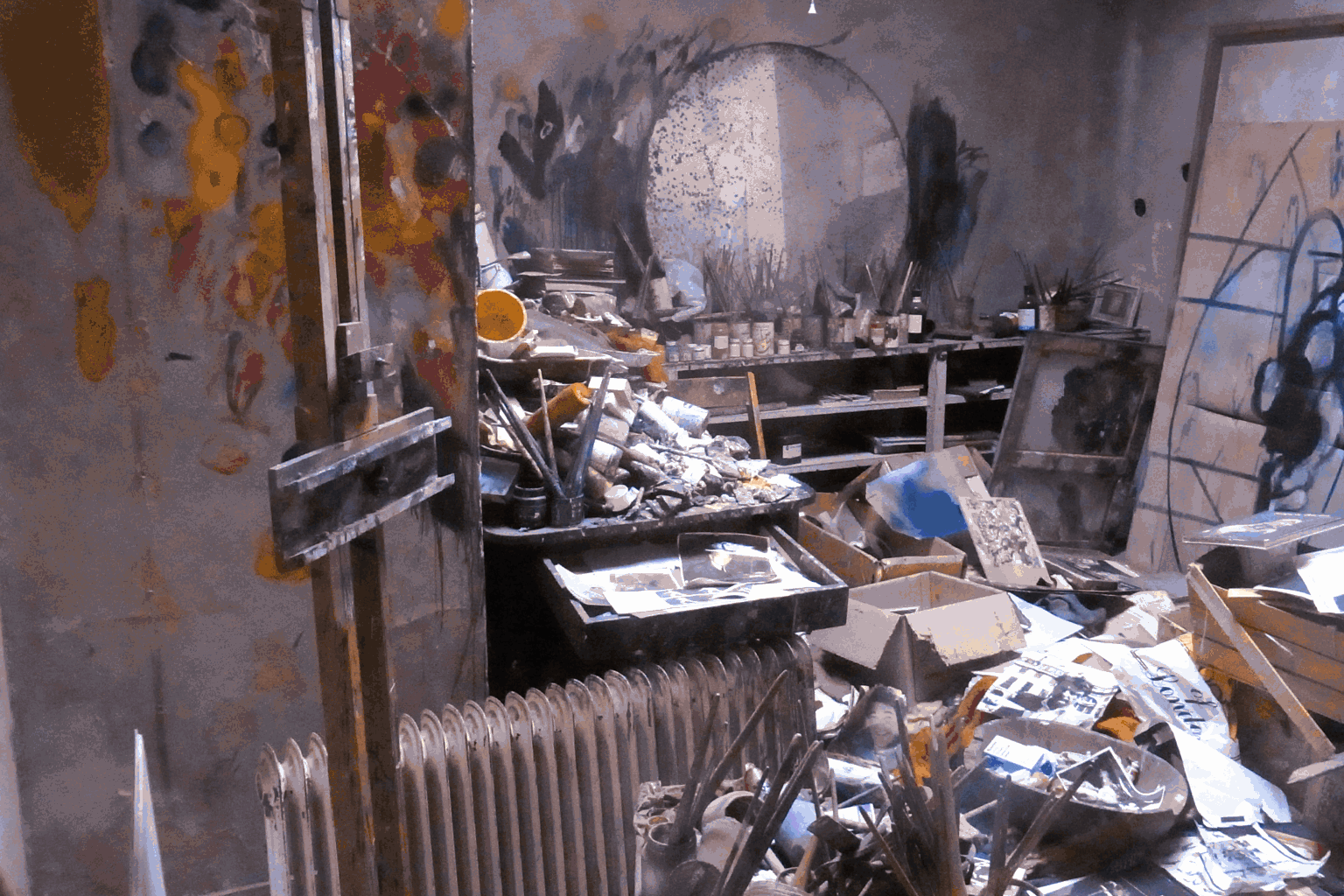
Francis Bacon's studio, reconstructed at the Hugh Lane Gallery in Dublin, Ireland. Bacon worked in the famously cluttered studio at 7 Reece Mews in London for more than three decades. Photo: Antomoro, 2016. Cropped from original. Free Art License 1.3, via Wikimedia Commons.
That question remains alive in studios today. In a recorded conversation in 2020, one American painter working in the Southern United States described the act of painting in explicitly spiritual terms. The artist, whose identity is withheld here, described surrendering to the creative process. He understood the experience of making his abstract works as God working through him. In the artist's account, a divine force makes the painting, guiding the selection of materials and the physical movement of the brush. He does not ascribe to himself the ultimate source of what emerges.
This is a striking proposition because it does not eliminate the artist from the creative act. It divides agency. The hand remains human. The manipulation of physical objects remains human. The decisions arrive through a human consciousness. Yet the artist experiences the source as something beyond himself. In this account, surrender does not mean abandoning the work but, rather, relinquishing the claim to being its sole originator.
Such experiences can be understood psychologically, neurologically, spiritually, poetically—or through some combination of all four. But they share a peculiar characteristic: the creator experiences a temporary reduction in the sensation of being completely in charge.
And then there are experiences that are harder to categorize or easily explain.
In 2023, in the studio of an artist working in the western United States, a small painting on a cradled panel was resting atop a very large gallery-wrapped canvas leaning against the studio wall. The artist, who will remain anonymous, reported seeing the small painting move away from the wall, completely clear the larger canvas beneath it, and lurch forward onto the floor.
The artist was alone. There were no other witnesses.
The artist has yet to establish what caused the event and reported being disturbed by what appeared to be the painting's autonomous forward movement. Had it simply slipped? Had it fallen downward? If so, why did it appear, from the artist's vantage point, to clear the much larger canvas entirely before reaching the floor?
The incident occurred in precisely the type of environment at the center of this inquiry: the studio—a place where artists have spent thousands of years confronting phenomena whose origins can be difficult to observe directly, including one of the most familiar and persistent of all: the arrival of a creative idea.
The Permanence of the Mystery
There is a temptation when looking backward through history to arrange everything into a reassuring progression: first humanity believed in spirits, then religion supplied God, then science arrived and explained everything. But intellectual history is rarely that tidy.
What persists is not one explanation, but a question: How much of the creative act is conscious?
Neuroscience, psychology, and religion continue to confront an experience human beings have been describing for a very long time. Language betrays this experience every day: An idea came to me. I lost myself in the work. I don't know where that came from. Something told me to try it. These familiar phrases describe creativity almost spatially—as though the idea and the creator occupied different territories until something crossed the distance between them.
Perhaps the ancient language of Muses and spirits was a way of describing this experience before another vocabulary existed. Perhaps religious traditions point toward something that material explanations cannot fully capture. Can several levels of explanation coexist? Is something else going on?
The mystery remains.