Mapping the World of Art: Part VII — The Architecture of Self-Definition
← Part VI — The Liberation of the Frame
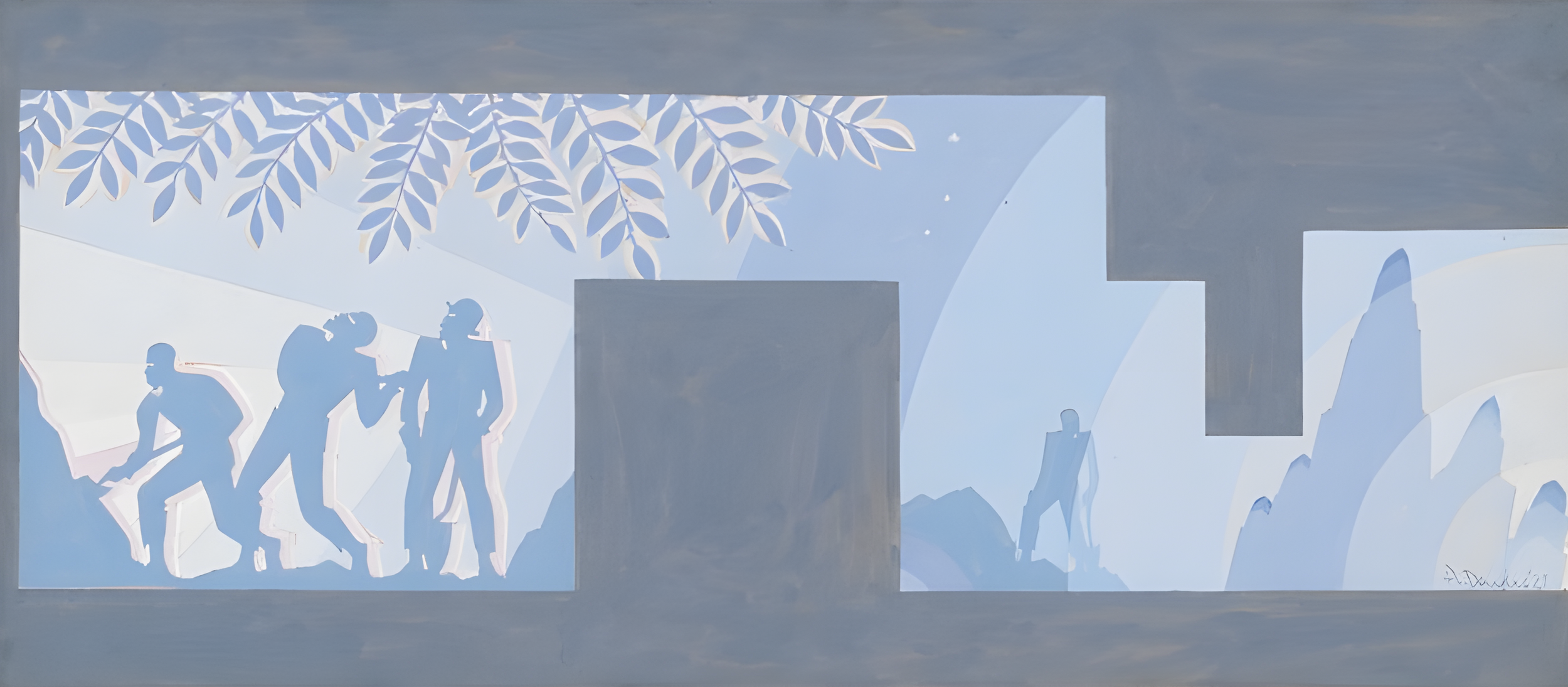
Aaron Douglas, Mural Study for Cravath Hall, Fisk University (1929). Public domain image via Wikimedia Commons / Whitney Museum of American Art.
In Part VI, we watched the Western map shatter. The total breakdown of the Renaissance window left artists standing among the fragments of a broken system. The singular European worldview had lost its monopoly on reality, and its artists were left scrambling for a visual language that could handle a destabilized world. But for Black Americans, navigating a fractured reality wasn't a twentieth-century artistic crisis—it was their historical inheritance.
As the Great Migration carried hundreds of thousands of Black families out of the soil of the Louisiana Delta and across the South toward cities such as Chicago, Detroit, and Harlem, a new map had to be drawn. This wasn't about begging for a place inside Europe's broken window. It was about building an entirely new architecture of representation.
The Intellectual Coup: The "New Negro"
In 1925, philosopher Alain Locke published a revolutionary anthology called The New Negro.
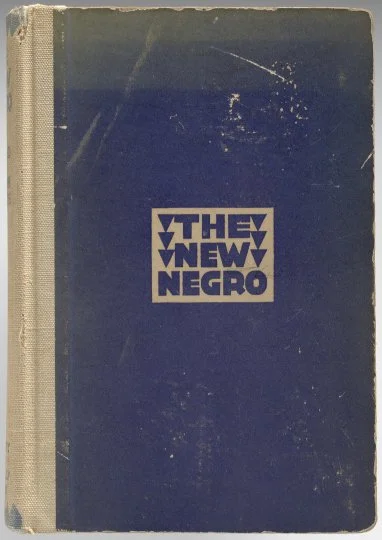
The New Negro (1925), edited by Alain Locke. Public domain image via the National Portrait Gallery, Smithsonian Institution.
Locke issued a direct challenge to Black artists: Stop treating European approval as the ultimate measure of artistic value. Locke reconfigured the system.
He argued that just as white Western artists looked back to Ancient Greece as the "classical" foundation of their civilization, Black artists needed to look back to classical African art—to the geometric genius of Egyptian, Nubian, and West African sculpture—as their own foundational blueprint.
This was an intellectual coup. It bypassed the entire European pipeline and claimed an older, grander lineage.
The Tool: Concentric Geometry
The visual mastermind of this shift was Aaron Douglas. Douglas didn't paint the world the way it looked; he painted the way history moved. To do this, he developed a precise graphic technology that combined the flat geometries of African sculpture with the clean lines of Art Deco.
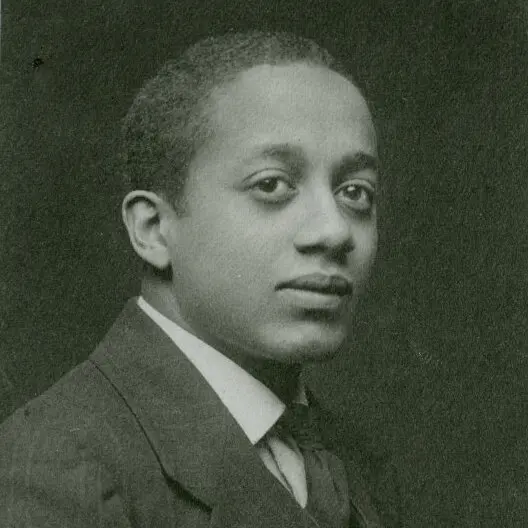
Alain Locke (c. 1920). Schomburg Center for Research in Black Culture, New York Public Library. Public domain.
Look closely at how Douglas constructs an image. He strips away the individual faces that Western art spent centuries perfecting and reduces human figures to sharp, powerful silhouettes. A silhouette turns a specific person into a universal archetype of labor, struggle, or triumph.
Next, notice his signature tool: Concentric Circles of Light. Douglas overlays translucent bands of a single color expanding outward from a central point—a book, a star, a silhouette of freedom. These circles act like visual sound waves. They inject the structural rhythm of jazz and the blues directly into the paint, forcing the viewer’s eye to move across the canvas in a syncopated beat.
Douglas wasn't using perspective to show you property. He was using geometry to show you Velocity—the movement of a people out of bondage and into the future.
Repairing the Rupture
The Harlem Renaissance is often celebrated for its music and poetry, but its deepest achievement was structural. Slavery had systematically severed family lines; migration had fractured communities. The Western map used these ruptures to claim that Black history was blank, unorganized, and empty.
The artists of Harlem used art to weld those broken pieces back together. In his murals, Aaron Douglas connected ancient Africa, slavery, the Great Migration, and modern city life within the same image, collapsing centuries into a single visual field. They proved that you do not need a single, uninterrupted Renaissance horizon line to have a cohesive history. You can build a world out of fragments.
Why This Matters in the Delta
This is the exact point on the map where the Northeast Louisiana Delta African-American Heritage Museum stands.
The artistic strategy of Harlem drew deeply from the kitchens, porches, churches, and cotton fields of the South. When a Delta quilter pieces together irregular scraps of denim, flannel, and cotton, she is solving a remarkably similar problem: how to transform fragments into coherence. She is refusing to let fragmentation win. She is taking the ruins of an exploitative system and organizing them into a masterpiece of warmth and memory.
The Harlem Renaissance reminds us that our culture was not given to us by the dominant frame. It was manufactured, piece by piece, through the deliberate labor of self-definition.
Where Are You?
You are standing at the crossroads of The Multi-Centric Map. The illusion of the single European story is dead. Harlem has proven that there are multiple centers of gravity in the art world, each with its own tools, its own history, and its own right to define reality. But the map is about to move from self-definition to direct confrontation.
In Part VIII, the frame becomes a shield and a weapon. We enter the fires of the Civil Rights Movement and the Black Arts Movement, where artists stop simply painting the history of their people and start using images to actively force the world to change.