Mapping the World of Art: Part III — Art and Power
← Part II — Before “Art”
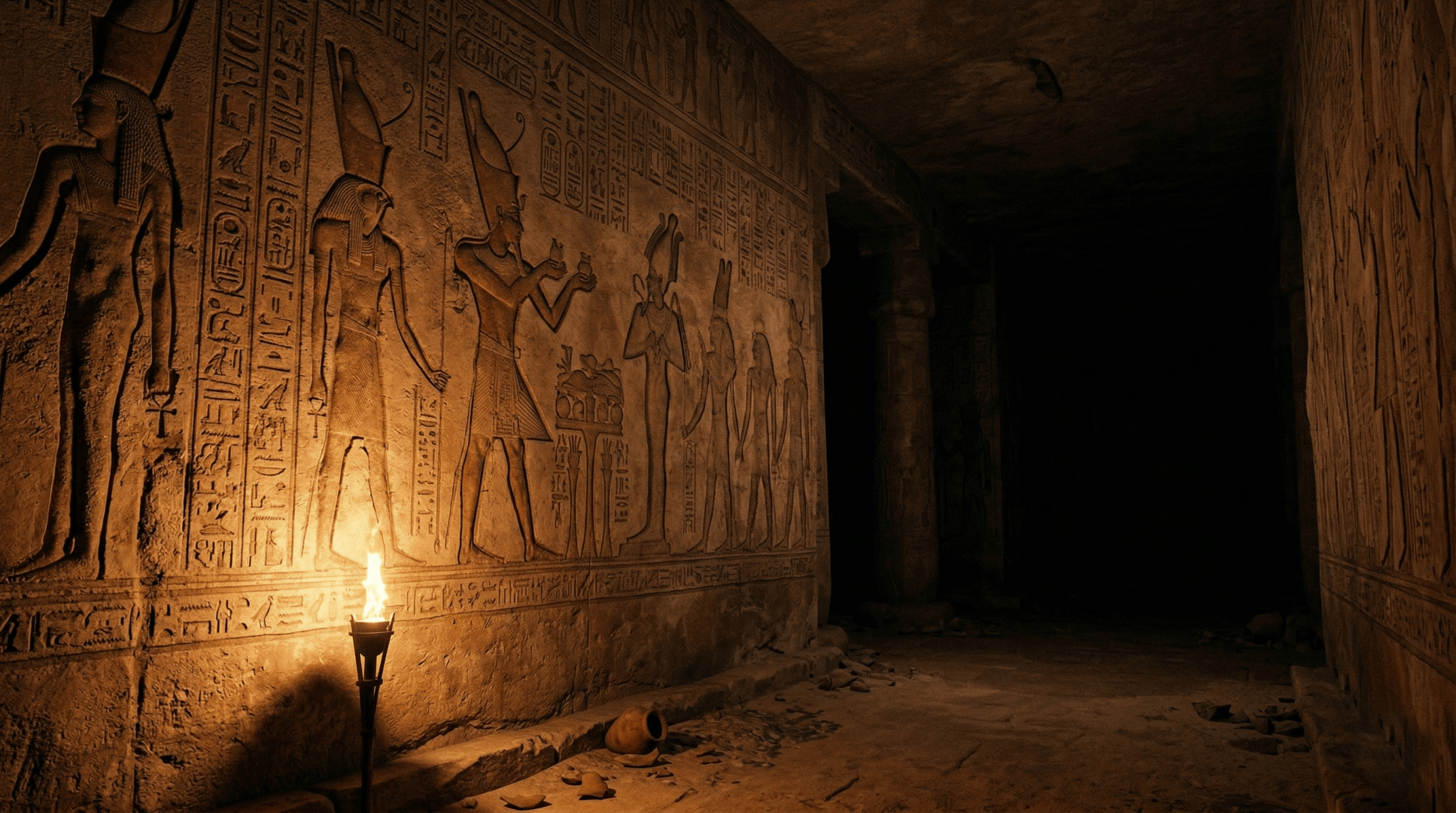
Torchlit reliefs show hieratic scale, where figures are sized by importance. Image generated using AI.
In the last section, we stood at the beginning — inside caves where human beings first began making marks, leaving behind traces of thought, observation, and experience. Now we move forward. The marks are still there — but something has changed.
Imagine stepping into a different kind of space. You are no longer in a cave. The walls are no longer uneven. The images are no longer exploratory. Everything here is ordered.
You’re inside a tomb in ancient Egypt — or a temple in Nubia, or a palace in Mesopotamia. The space is covered from floor to ceiling with figures: painted, carved, arranged with precision. At first glance, it feels familiar: people, animals, scenes of life.
Looking closer, it becomes clear: every figure follows a rule. Heads in profile. Eyes face forward. Shoulders turned. Legs striding in the same direction. The body is not observed in a single moment. It is constructed according to a canon of proportions—a mathematical grid.
In Egypt, that grid measured the human figure as 18 squares from the soles of the feet to the hairline. This is known because unfinished tomb walls at Amarna and Deir el-Medina still show the red grid lines artists painted first. Nothing was left to chance. This is the moment when image-making changed. In the world of early civilizations, images are tools that organize experience and sanction power.
Scale As A Statement
In ancient Egypt, scale is based on importance rather than physical size. A pharaoh towers over others because he is larger in meaning. Servants, prisoners, and animals are reduced accordingly. This is called hieratic scale, a visual declaration of how the world is ordered—and who belongs at the top.
The same logic governs pose, where the goal is clarity, permanence, and legibility across centuries. The Egyptian term for “sculptor” translates to “he who keeps alive,” emphasizing that the artist was less a decorator than a technician of the eternal.
These conventions were maintained by institutions: the priesthood, the royal court, the scribal workshops. They were taught, repeated, and enforced through training and patronage. To depict the pharaoh at a smaller scale than a noble was incorrect and unthinkable.
Art As Technology
Academic art history distinguishes between aesthetic art—made to be experienced as beauty—and instrumental art—made to function.
Egyptian art is profoundly instrumental. In tombs, scenes of farming, hunting, and feasting were meant to sustain the deceased beyond death, ensuring continuity between worlds. The more complete and orderly the image, the more powerful its magic. In Mesopotamia, carved reliefs show rulers hunting lions, leading armies, receiving tribute. These images declare order and authority.
Power is made visible. More importantly, it is repeated—across walls, across cities, across generations. The same visual language appears again and again. The same poses. The same proportions. The same symbols.
This is how a system takes hold. Unlike the marks in caves, systems are not isolated acts. They are coordinated, reinforced, and maintained by institutions with real political and religious stakes.
Key Terms to Carry With You
- Hieratic Scale
- Size equals importance, not physical measurement.
- Canon of Proportions
- A mathematical grid — often 18 squares tall — that ensured every figure followed the same rules.
- Frontal Eye
- The eye shown as if from the front, even on a profile face — believed to preserve the eye's magical power.
- Instrumental Art
- Art made to do a job — sustain the dead, declare victory — rather than simply to be looked at.
The Nubian Connection: Visual Sovereignty
For institutions focused on African American heritage, the Nubian Kingdom of Kush — in what is now Sudan — is especially important. Nubian pharaohs, particularly those of the 25th Dynasty, conquered and ruled Egypt. But rather than erase Egyptian visual culture, they adopted and adapted its canon of proportions, its hieratic scale, its frontal eye.
Why? To claim legitimacy. To say: We are rightful rulers of the Nile Valley. Our power follows the same cosmic order.
This is visual sovereignty: using an existing system of images to assert your own authority.
The Egyptian pharaoh's oversized figure, the Nubian king's adopted grid, and the African American sharecropper's absent portrait are not unrelated. They are different answers to the same question: What does an image do to power? Just as Nubian pharaohs adapted royal imagery to claim authority, Black artists today adapt, subvert, and reclaim visual language to assert dignity, presence, and self-determination. That continuity is part of what the Northeast Louisiana Delta African-American Heritage Museum exists to trace.
Where Are You?
You are no longer at the beginning. You are inside the first fully organized systems of image-making—where art is tied to belief, authority, and control. What often follows is a story about Greece: that Greek artists discovered observation, freed themselves from Egyptian rules, and invented naturalism.
That story is incomplete. Egyptian artists were superb observers; they simply chose a different set of priorities—hieratic scale, ritual clarity, cosmic order—over momentary realism. Greek art did not replace system with observation. It replaced one system with another. Both serve power, just in different ways.
A deeper problem emerges in the 18th and 19th centuries. European art historians recast Greek art as the pinnacle of human achievement and claimed the Greeks as racially “pure white.” This White Marble myth helped justify racial hierarchies, including systems that upheld the enslavement of African people. The distortion is not in the Greek art itself, but in how it was used to construct a false story about who gets to be seen as beautiful, civilized, and powerful.
Understanding that distinction matters. In Part IV, we will look at how the Greek system actually emerged—what it gained, what it lost, and what it was later made to say.