10 Things Lovers of Art Should Know
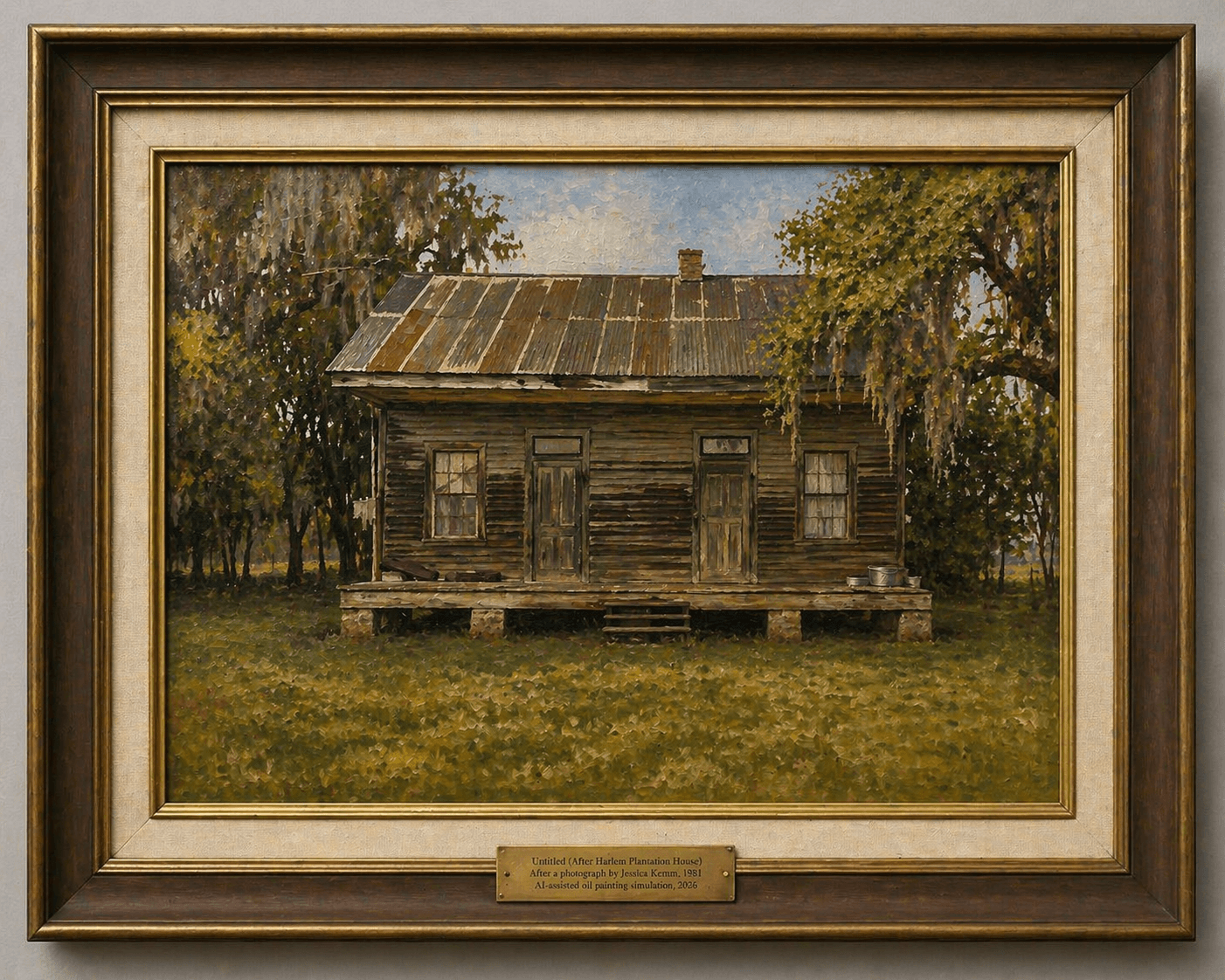
After Jessica Kemm, Harlem Plantation House, Plaquemines Parish, Louisiana, 1981. Original photograph by the U.S. National Park Service (public domain). AI-assisted rendering, 2026.
1. You're already a collector.
If you have a favorite artist, a painting that stopped you in your tracks, or an image you've never forgotten — you already have a collection. It lives in your mind. That is your collection in its purest form. The question is whether you're ready to bring it into the physical world. If you are, there are a few things worth knowing first.
2. Regional art carries a different kind of value.
Not all art appreciates the same way, and not all value is financial. Work made within a specific place — shaped by its landscape, its history, its particular way of seeing — carries something that internationally traded art often doesn't: irreplaceability. A painting made in the Delta, by an artist who grew up in the Delta, about something that exists only in the Delta, cannot be authentically expressed elsewhere. That specificity is the work's greatest asset. When you collect regionally, you are acquiring something singular.
3. What makes a work last.
A piece of art that moves you today may not hold its meaning to you over time. The works that endure — in a collection, in a culture, in memory — tend to share a few qualities: a distinct visual language you can recognize without a label, technical command whether classical or experimental, and a connection to something larger than the moment in which it was made. These are patterns worth noticing. When standing in front of a work and asking yourself whether to bring it home, the question is, "will I still want to live with this in ten years?". Art that answers yes is worth the find.
4. The Delta has a lineage.
The art being made in Northeast Louisiana today comes out of a long, largely undocumented tradition of making — quilts, carvings, paintings, murals, objects fashioned from whatever the land and the moment provided. Much of that tradition was never formally recorded, but passed hand to hand, eye to eye, across generations that did not have broad access to institutions or galleries or critics. That history lives in the work being made here right now. When you collect a contemporary Delta artist, you are stepping into a lineage. Knowing that lineage — even partially — changes what you see in the work, and what the work means in your hands.
5. Local materials tell local stories.
Some of the most compelling art isn't made with materials ordered from a catalog. Much of it is made with materials found on hand. In the Delta that can mean: reclaimed wood from old structures, worn metal, or fabric worked by hands in other ways. When an artist chooses a material, that choice becomes part of the work's meaning. As a collector, learning to read materials — where they came from and why the artist chose them — opens up a layer of the work that rarely appears in a title or an artist statement. The object itself becomes the story.
6. Some things won't exist much longer.
The Delta is changing. Structures that defined the landscape for generations are disappearing — maybe not dramatically, but quietly, one season at a time. The shotgun house at the end of a road. The storefront that hasn't opened in twenty years. The field that will be developed into something else by spring. Artists who work in this landscape are making a record of it, often without that being their stated intention. They are simply painting what they see before it's gone. A collection built with any awareness of this is participating in an act of preservation. The subject of what you choose to bring home may one day be the only evidence that it existed at all.
7. Provenance matters.
Provenance is simply the history of an object — where it came from, who made it, who has owned it, and how it moved through the world before it reached you. In major art markets, provenance can determine whether a work is worth thousands or millions. In regional collecting, it works differently but it matters just as much. Knowing that a work was made by a specific artist, in a specific place, during a specific period of their life, is not just biographical trivia. It is the difference between an object and a document. In the Delta, where so much artistic history has gone unrecorded, the simple act of keeping paperwork — a receipt, a photograph, a note in the artist's own hand — can be the thing that preserves a work's full meaning for the next generation of collectors. Don't let that information get lost. It may be irreplaceable.
8. Local and global are not opposites.
The most interesting collections are rarely built from a single source. A work made from reclaimed Delta timber can hang beside a print acquired from a gallery in New York or a piece brought back from Japan. Each makes the other more interesting by comparison. Collecting beyond your region expands your collection's identity, placing what you love about where you're from in conversation with the rest of the world. And that conversation goes both ways.
9. Emerging artists are not all the same.
The term "emerging artist" gets used as though it describes a single category of risk — young, unproven, affordable, speculative. But emergence looks different depending on where it's happening. In a major metropolitan market, an emerging artist likely has access to networks, institutions, critics, and collectors that can accelerate a career quickly. An emerging artist in the Delta on the other hand, operates in a different landscape entirely — one where talent may be abundant but infrastructure is not. Here, recognition often comes late if at all, and the decision to keep making art is itself a form of commitment that deserves attention. Supporting an emerging Delta artist often means the difference between a career continuing or not. That context changes what your support means — and what it's worth.
10. You are what you collect.
Brillat Savarin famously said, "Tell me what you eat and I will tell you who you are." In that same vein, what you collect tells others who you are. Your collection is a self-portrait that accumulates over time through a series of choices that each felt right in the moment. What you were drawn to. What you couldn't leave behind. What you saved up for and what you bought on impulse. What you hung where everyone could see it and what you kept somewhere private. Together, those choices say something true about who you are — your history, your values, what you find beautiful, what you think is worth preserving. The most meaningful collections aren't the most expensive or the most impressive, but the most honest. Build yours that way, and it will be worth what no market can measure — to you, to the people who know you, and eventually, to people who never will.
At the Northeast Louisiana Delta African-American Heritage Museum, we believe that collecting is one of the most personal and powerful ways a community holds onto itself. The art of this region — its lineage, its materials, its urgent beauty — deserves to be seen, preserved, and owned by the people who understand it best. We invite you to be one of them.