Mapping the World of Art: Interlude — The Politics of Sight

Penelope, by Franklin Simmons (19th century). A later interpretation of classical ideals that came to define how the human form was seen and judged. Credit: Penelope, by Franklin Simmons. Photo by Wonderlane, via Flickr. Licensed under CC BY 2.0.
In Part III, we looked at structured systems—how ancient cultures used visual conventions like hierarchy of scale to make power visible. It’s easy to look at those rigid, two-dimensional figures and think:
“They just hadn’t learned how to see the world realistically yet.”
But that is a trap. It assumes that seeing is a natural, objective act—like a camera recording light.
It isn’t.
Seeing is a learned behavior. It is a piece of cultural software that tells your brain which parts of the world to keep and which parts to ignore.
The Illusion of Objectivity
To understand this, look at the lines below.
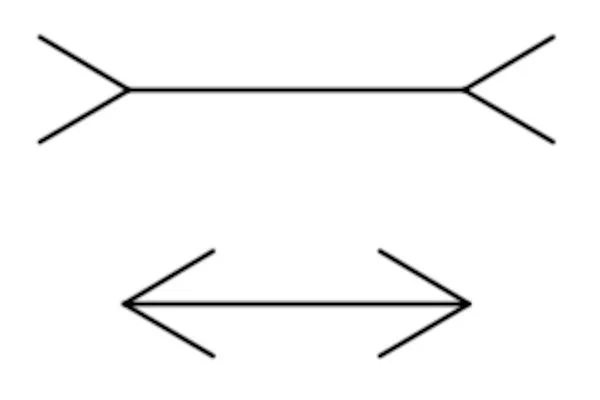
The Müller-Lyer illusion shows how perception is shaped by learned visual cues—what you see is not always what is physically there.
They are the same length, but depending on the environment you were raised in, your brain may insist that one is longer than the other.
This is known as the Müller-Lyer illusion.
Research has shown that people raised in “carpentered worlds”—environments dominated by right angles and rectangular architecture—are more susceptible to this illusion. Their brains have been conditioned to interpret certain angles as depth cues.
If a simple set of lines can influence what you see, imagine what a lifetime of cultural systems can do. You don’t just see with your eyes. You see with your expectations.
The “Evolution” Fallacy
As we move toward the art of Ancient Greece, we encounter a style often described as naturalism—where figures appear to breathe, where muscles flex, and weight shifts. Many art history narratives present this as an improvement—as if humanity finally “figured out” how to see the human body correctly.
But the Greeks did not see better than the Egyptians. They saw differently.
Egyptian systems prioritized the eternal. They organized the human figure to express stability, continuity, and cosmic order.
Greek systems would begin to prioritize the moment—focusing on movement, proportion, and the mechanics of the human body in time. One is not more correct than the other. They are different ways of structuring perception, each shaped by the needs and beliefs of the culture that produced it.
Why This Matters in the Delta
At the Northeast Louisiana Delta African-American Heritage Museum, we are, in many ways, in the business of re-seeing.
Over time, the Western world privileged the Greek lens—treating it as a standard against which other traditions were judged. The closer a work aligned with the later ideal of the white marble Greek figure, the more it was associated with ideas of refinement or civilization.
This framework influenced how people were taught to look. It shaped how African art was interpreted. It shaped how the lived experiences of communities like those in the Delta were understood—or misunderstood.
Work that did not align with that framework was often labeled “primitive” or “unorganized”—terms that reveal the limits of the system used to evaluate them, rather than the complexity of the work itself.
When we recognize that seeing is learned, something shifts. We gain the ability to question the lens. We begin to understand that what we are looking at is not simply what is there—but what we have been trained to recognize.
From that position, it becomes possible to see differently. To recognize the visual language of a Nubian pharaoh not as stiffness, but as a deliberate expression of permanence and authority.
To see a Delta quilt or a sharecropper’s portrait not as something outside the history of art, but as a sophisticated visual language shaped by necessity, memory, and survival.
Where Are You?
You are standing at the threshold of a major shift. The map is about to change.
We are moving from the world of structured systems—where images define order—to a world where observation itself becomes the focus. But as we move forward, hold onto this question:
Who is doing the observing—and what are they teaching you to see as “natural”?
In Part IV, we step into the light of the Mediterranean to see how one way of seeing came to be widely adopted—and what that shift made possible. -