Mapping the World of Art: Part IX — The Frame as Weapon
← Part VIII — The Great Unraveling
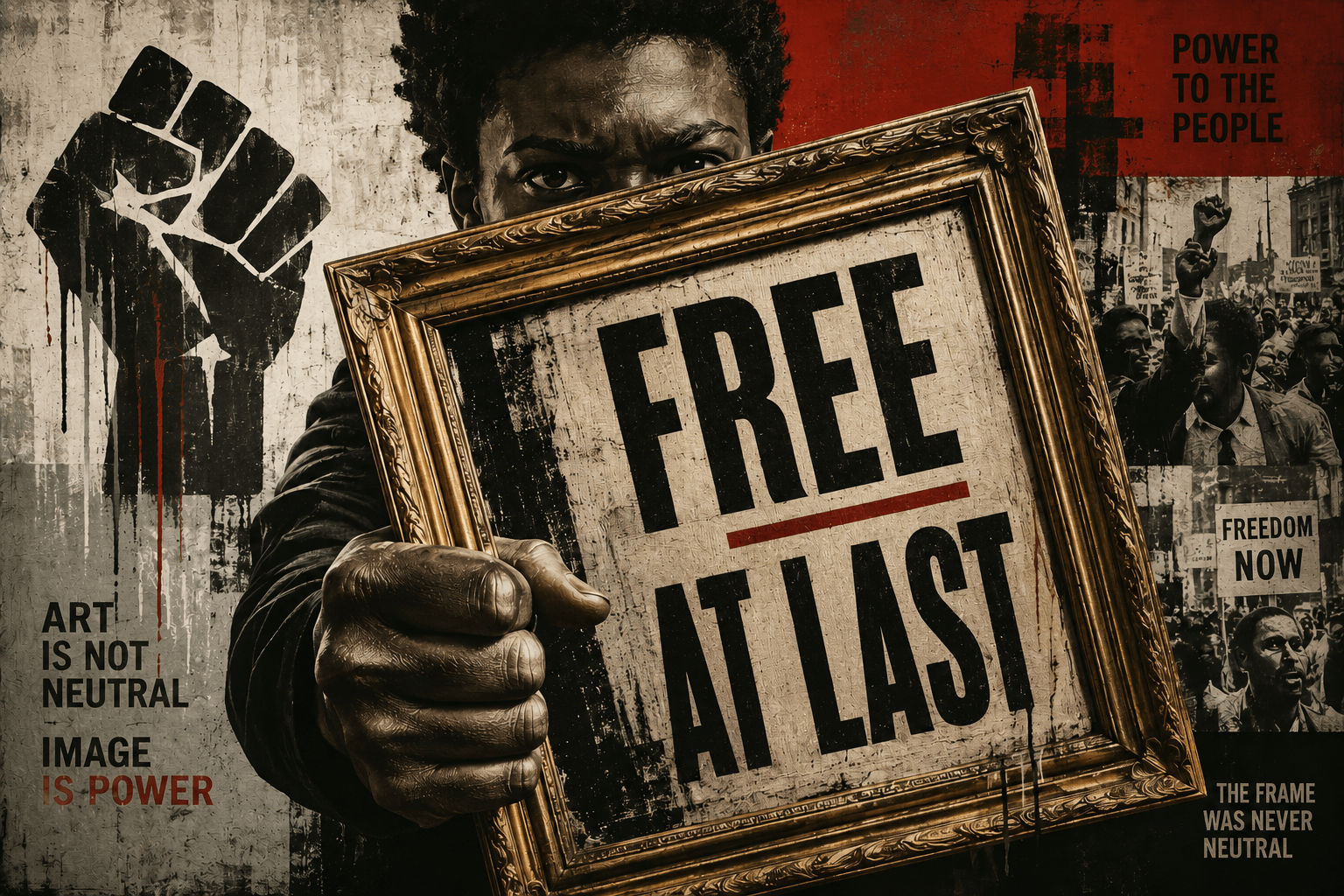
The frame is never neutral. In the Black Arts Movement, the frame itself became a tool of cultural resistance. Credit: Original illustration created with AI for the Northeast Louisiana Delta African-American Heritage Museum.
In Part VIII, we stepped back and watched the old Western order unravel from within. One generation of European artists after another challenged inherited rules until the centuries-old monopoly on artistic truth collapsed. By the early twentieth century, the single, linear road that had stretched from Ancient Greece through the Renaissance had finally run out of ground.
But freedom creates its own question: If the old rules no longer define reality, who does?
For Harlem, the answer was self-definition. Black artists refused to measure themselves against standards that had never been built for them. They established a new cultural center rooted in African classical history, nourished by the Great Migration, and powered by a renewed confidence in Black identity. But by the 1960s, a new generation of artists believed that self-definition, by itself, was no longer enough. The frame had to become a weapon.
From Identity to Action
The Harlem Renaissance asked a profound question: Who are we? The Black Arts Movement asked an even more demanding one: What are we going to do with that knowledge?
This argument was no longer taking place inside quiet museums or university classrooms. It unfolded in neighborhoods, churches, schools, community centers, and on city streets. The artwork itself became part of the political infrastructure.
Posters announced rallies. Murals reclaimed public walls. Prints spread ideas faster than expensive oil paintings ever could. The frame was no longer simply representing history; it was actively participating in it.
The New Visual Language: Street Tech and Shadow Boxes
If Aaron Douglas built an architecture of self-definition, artists in the 1960s and 1970s transformed visual language into direct confrontation.
Working as the Minister of Culture for the Black Panther Party, Emory Douglas abandoned the isolation of the gallery and embraced the technology of the street: the cheap, mass-produced weekly newspaper print.
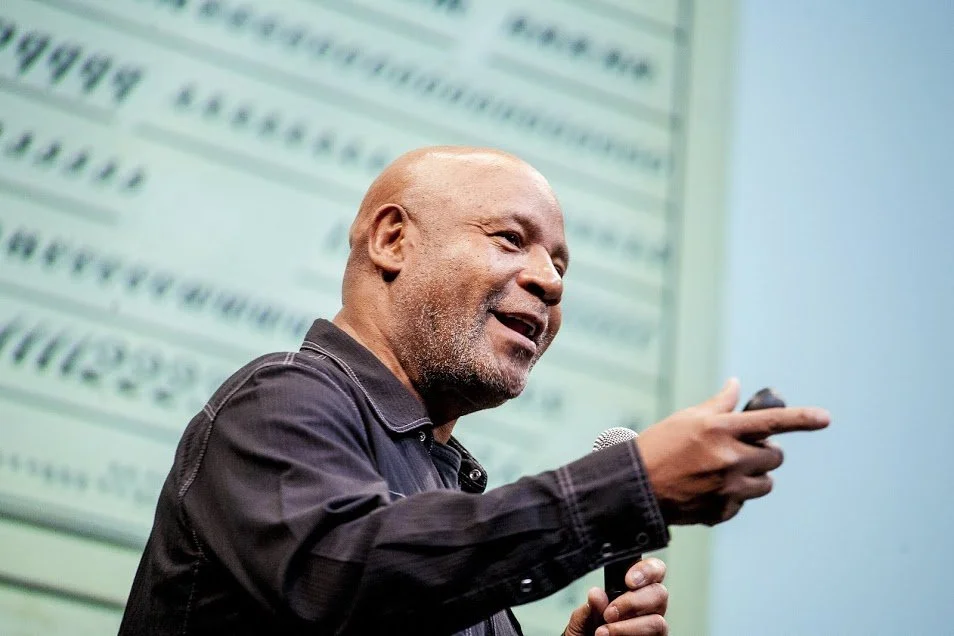
Emory Douglas speaking at Typo San Francisco in 2014. As Minister of Culture for the Black Panther Party, Douglas developed a bold graphic language that transformed posters and newspapers into tools of political communication. Photograph by Amber Gregory (FontShop), 2014. Licensed under CC BY 2.0.
Douglas engineered a precise graphic style designed to survive low-quality newsprint presses. He used brutal, heavy black outlines, simplified silhouettes, and textured screentone sheets to create high-contrast compositions that exploded off the page. He illustrated ordinary Black men, women, and children with dignity, strength, and agency, often alongside symbols of community self-defense. His posters were stapled to telephone poles and taped to storefront windows. The purpose of the image was stripped of academic pretense: Does this work help liberate our people?
At the same time, artists such as Betye Saar proved that the frame could be used to ambush hostile imagery.
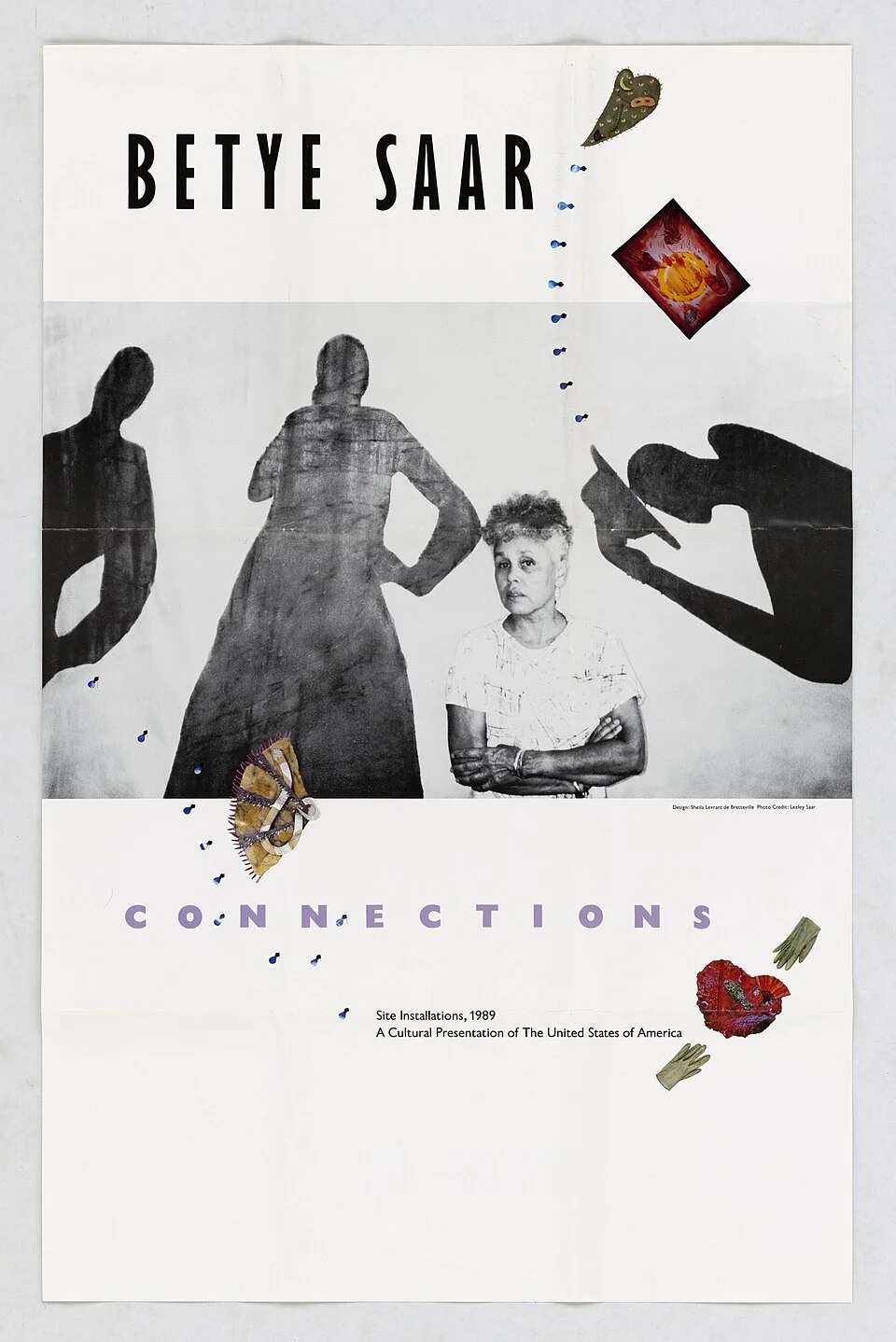
Betye Saar: Site Installations poster, 1989. Saar’s work helped expand the frame of political art through assemblage, memory, found objects, and the transformation of inherited imagery. Credit: Betye Saar: Site Installations, 1989. U.S. Information Agency / National Archives at College Park, via DPLA. Public domain in the United States.
In her revolutionary 1972 assemblage, The Liberation of Aunt Jemima, Saar weaponized the three-dimensional depth of a shadow box. She took a derogatory, mass-produced mammy caricature and reassembled its meaning from the inside. She layered the background with repetitive Aunt Jemima logos, filled the bottom with real cotton, and transformed the caricature by placing a rifle in one hand, a broom in the other, and a revolutionary Black Power fist rising directly in front of her patterned skirt. Saar hijacked a degrading stereotype and rebuilt it as an icon of resistance.
Artists such as Faith Ringgold expanded this transformation even further, demonstrating that quilts, painting, and handwritten storytelling could preserve memory while aggressively confronting injustice. Under this pressure, the artificial boundaries between fine art, craft, history, and activism became impossible to separate.
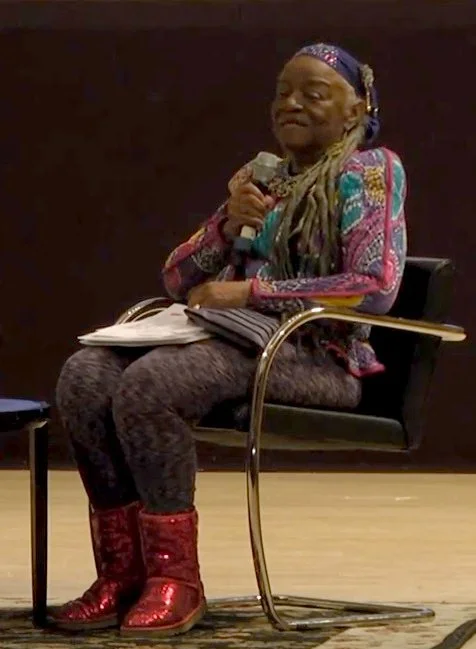
Faith Ringgold speaking at the Brooklyn Museum's "We Wanted a Revolution" symposium in 2017. Through painting, quilts, and storytelling, Ringgold expanded the possibilities of political art while preserving Black history and lived experience. Credit: Screenshot from a Brooklyn Museum video (2017), licensed under Creative Commons Attribution 3.0 (CC BY 3.0).
The Delta Infrastructure of Survival
For the Northeast Louisiana Delta African-American Heritage Museum, this chapter is not a distant artistic trend. The Delta has long understood that culture must become action to guarantee survival.
During the Civil Rights struggle, the visual and material tools of resistance were manufactured out of sheer necessity in the Black-owned printing shops, textile circles, and church basements of the South.
A mimeographed church bulletin wasn't just a religious program; it was an underground tactical flyer organizing a voter-registration drive.
A handmade sign wasn't an art project; it was a shield carried into a protest march.
A Delta quilt wasn't just a bed covering; it was an act of economic sovereignty and a text written in fabric by people whose literal literacy had historically been criminalized.
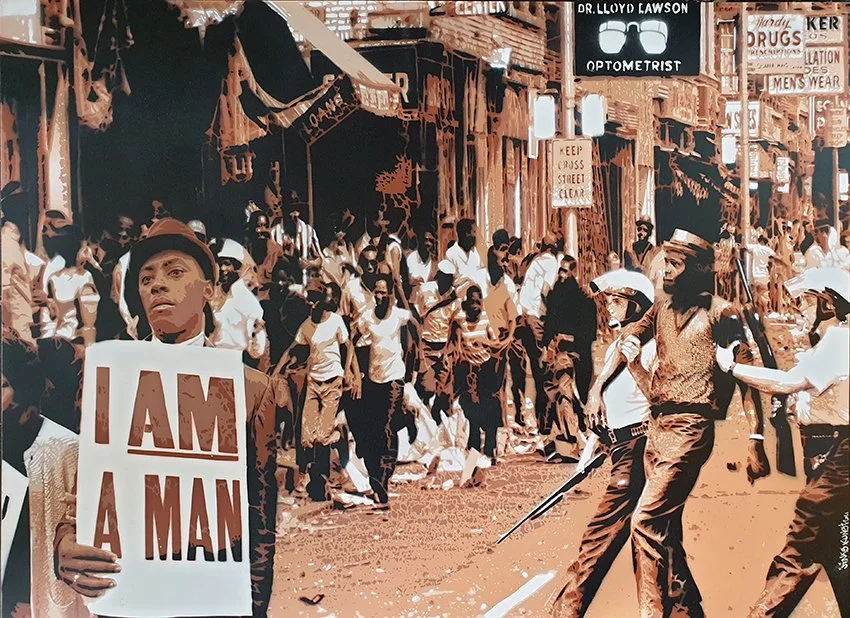
The phrase "I AM A MAN" became one of the defining visual symbols of the Civil Rights Movement. This contemporary stencil artwork demonstrates how that simple combination of words continues to function as a powerful work of visual culture decades later. Credit: Stencil artwork and photograph by Franck Garnier (2021). Licensed under Creative Commons Attribution–ShareAlike 4.0 (CC BY-SA 4.0).
The Black Arts Movement gave this strategy a national vocabulary, but its roots reached deep into the soil of places like the Delta. Long before major museums began collecting these objects, Black families relied on them to preserve identity, anchor communities, and actively engineer freedom.
Beyond the Gallery
The Black Arts Movement permanently changed the baseline question of art history. For centuries, the dominant question of the academy had been: Is it beautiful?
Now, another question demanded equal authority: Who does it serve?
An artwork could still be beautiful, but beauty alone was no longer sufficient. Art was reclaimed as a cognitive technology that could educate, organize, protest, heal, preserve memory, and transform the way a community understood its own power.
Where Are You?
You are standing at the point where art fully enters public life.
No longer confined to palaces, academies, or elite galleries, the frame now moves through neighborhoods, classrooms, newspapers, protest marches, and family homes. Art has become something every community has the right to claim, reshape, and use.
One final step remains. Over the past nine installments, we have traveled from prehistoric caves to Egyptian grids, from Greek ideals to Renaissance perspective, from the collapse of the old artistic order to Harlem, and finally to the moment when art became an active instrument of cultural transformation.
Now, it is time to return to the map itself.
In Part X, we pull back one final time to answer the question that has guided this entire journey: What is art history for?
And more importantly: What does it mean to possess visual sovereignty in a world still shaped by inherited ways of seeing?
Mapping the World of Art:
You are almost at the end of the map.