Who Owns Color?
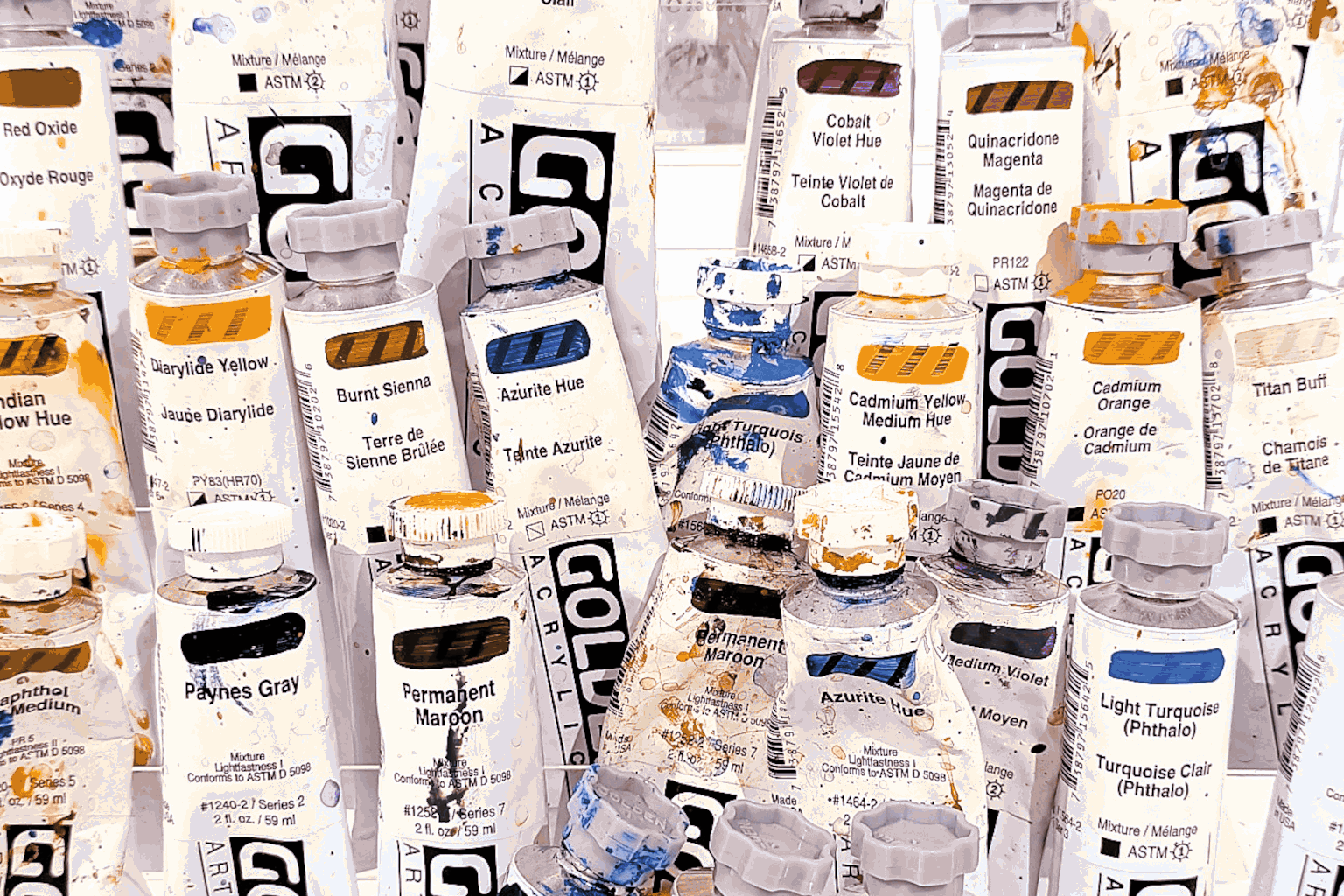
Professional artist colors transform manufactured pigments into the familiar materials of the painter’s palette—raising a less familiar question: who makes, profits from, and ultimately owns color? Photo credit: TWCarter U4100 / Wikimedia Commons, CC0 1.0
Knowledge, Extraction, and the Black History of Pigment
Walk into an art supply store, and there they are: cadmium red, yellow ochre, burnt sienna, raw umber, ultramarine, cobalt, ivory black, and Prussian blue. Painters tend to think of these colors as materials squeezed from tubes, mixed on palettes, and judged by permanence, transparency, tinting strength, and undertone.
But who made the color itself? Or perhaps more importantly, who got paid for possessing that knowledge?
Before America’s Blue Industry
In the case of indigo, its history was established in West Africa long before Britain’s North American colonies became major producers of the dye, a process that required far more than harvesting a plant. Indigo production depended upon biological and chemical transformations that a maker had to understand. This was technical knowledge, and Africans possessed it.
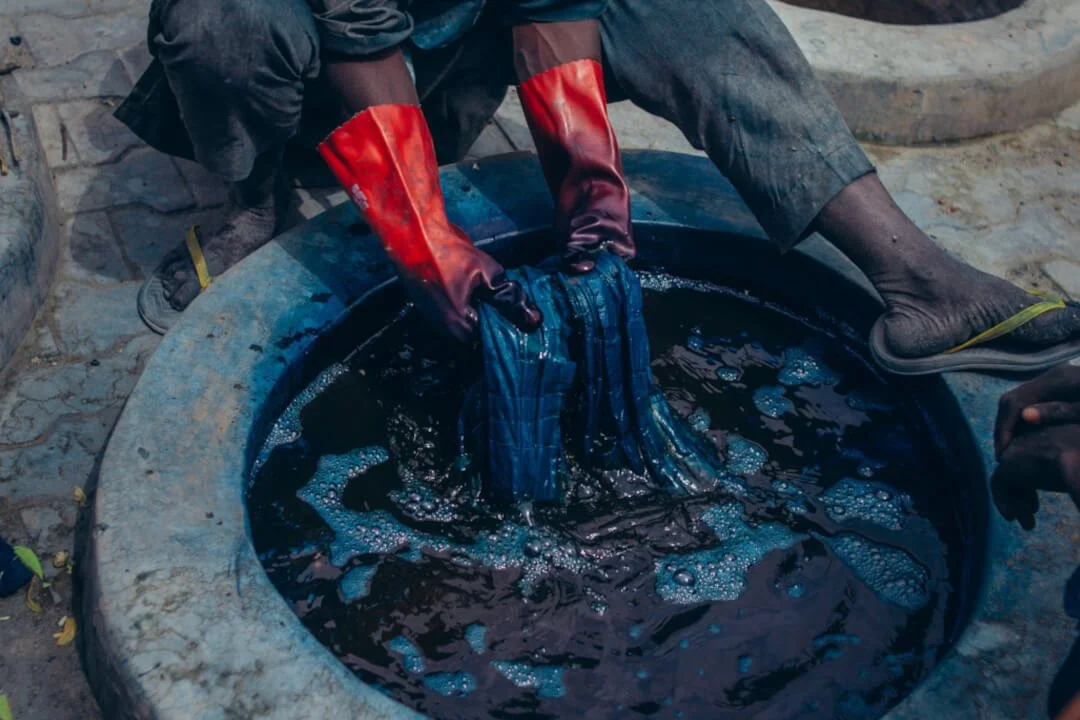
Indigo dyeing at the historic Kofar Mata dye pits in Kano, Nigeria. Producing blue requires skilled control of a complex dyeing process—material knowledge with deep roots in West Africa. Photo credit: Shots by abdul / Wikimedia Commons, CC BY-SA 4.0.
Through the transatlantic slave trade, Africans, including children, were kidnapped and transported, bought and sold, torn from their families, and confined through law and physical force. With them was the technical knowledge of making color. They and the knowledge they carried were stolen and claimed as property.
Imagine a corporation today kidnapping people who possessed valuable technical knowledge, imprisoning them, forcing them to use that knowledge without compensation, and selling the resulting product for profit. This is precisely what happened, particularly in the American South.
Blue Gold
By the middle of the eighteenth century, indigo had become one of South Carolina’s most valuable commodities, its production encouraged by British subsidies. Merchants handled the dye, ships carried it across the Atlantic, and enslaved Black people empowered the system through technical know-how.
Eliza Lucas Pinckney, a white planter central to the traditional story of South Carolina indigo, left behind extensive correspondence. But surviving records also preserve the names of some of the enslaved specialists whose expertise helped make that industry possible. John “Quash” Williams, an enslaved carpenter, built specialized wooden indigo works for the Lucas plantations and assisted with their indigo operations. A woman known as Hagar, enslaved on a Laurens plantation, became known for her skill in drying wet indigo material into stable cakes suitable for storage and export.
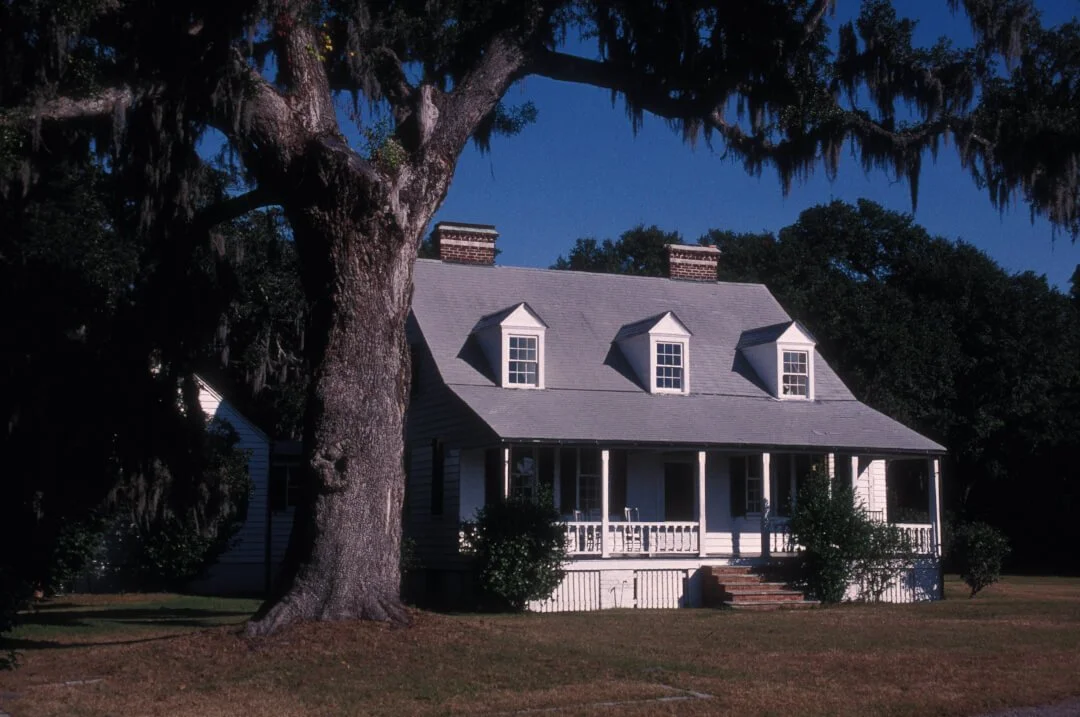
Snee Farm in South Carolina was owned by the Pinckney family from 1754 to 1817 and operated as a plantation producing indigo, rice, livestock, and other commodities through enslaved labor. The house visible today dates to about 1820, after the Pinckneys’ ownership—a reminder that the surviving landscape can outlast the labor system that created its wealth. Photo credit: Jerrye & Roy Klotz, MD / Wikimedia Commons, CC BY-SA 3.0
These were not interchangeable hands performing unskilled work. They were economically valuable repositories of knowledge, and because they were enslaved, that knowledge could be appropriated along with their labor. Today we might describe their valuable proprietary techniques as intellectual property. At the time, enslaved specialists possessed no comparable legal right to control, license, sell, or profit from their own expertise. They were forced to produce value while someone else received and controlled the proceeds.
This Is Louisiana History
Beginning in 1719, slave ships transported thousands of enslaved Africans into colonial Louisiana. During the colony’s early decades, a majority came from Senegambia, part of a West African world in which indigo cultivation and dyeing had long histories. Enslaved Africans brought agricultural and technical knowledge with them, including knowledge of crops such as rice, tobacco, cotton, and indigo.
Who Kept the Money?
Indigo fueled shipping, finance, manufacturing, and international commerce, generating wealth far beyond the plantation. The enslaved people whose labor and technical knowledge helped create that value did not share in the capital it produced, a distinction that reverberates across generations. Profits purchase land, businesses, education, and other assets. They can be inherited. Yet those profits were not used to compensate the people whose unpaid labor had helped create them.
By the late nineteenth century, synthetic chemistry was transforming color production. Value increasingly moved from agricultural land and fermentation vats toward laboratories, factories, scientific education, manufacturing equipment, capital, and patents.
George Washington Carver
Carver was an artist as well as a scientist. As a child, he experimented with colors made from berries, seeds, flowers, and other natural materials. At Tuskegee Institute, he turned his attention to the clays of Macon County, Alabama, which he described as ranging from snow-white through siennas and reds to yellow ochres and creams.
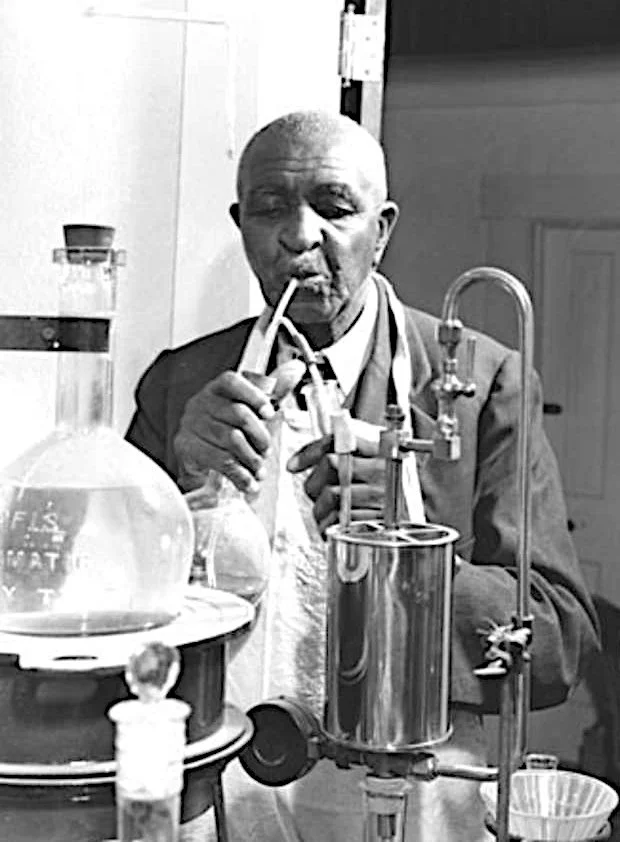
George Washington Carver at work in his laboratory. Carver’s experiments extended beyond agriculture into paints, pigments, stains, and the chemistry of Alabama clays. Photo credit: USDA Agricultural Research Service / National Agricultural Library, Public Domain
Carver investigated ways to transform inexpensive local materials into useful paints and finishes. His 1911 Tuskegee bulletin, White and Color Washing with Native Clays from Macon County, Alabama, documented the range of colors available in local soil and explained how rural families could use native clays to make inexpensive finishes.
He also developed chemical processes and patented them. In 1925, Carver received U.S. Patent No. 1,541,478 for a process that treated iron-rich clay with acids and iron to produce paints, pigments, fillers, and stains. Two years later, another patent described a process that would eventually become central to an extraordinary contemporary experiment involving a vivid blue pigment.
The contrast with the enslaved color makers who preceded him is striking. Carver’s knowledge entered the legal record claiming authorship of the process under his own name: George W. Carver, inventor.
Carver Blue Lives Again
Nearly a century later, Chicago artist Amanda Williams encountered Carver’s little-known 1927 pigment patent while researching Black invention. Fascinated, she spearheaded an effort to reconstruct Carver’s procedure and pigment using modern laboratory equipment and safer, faster methods.
Researchers at the University of Chicago produced a striking blue precipitate, and X-ray analysis showed that its crystal structure matched Prussian blue. A German manufacturer subsequently scaled the process, producing roughly 100 pounds of pigment for Williams. For Prospect.6 in New Orleans, she used Carver Blue on buildings at Xavier University of Louisiana and the New Orleans African American Museum.
Back to the Art Supply Store
Professional painters today can choose among color houses whose identities are closely tied to their founders and philosophies of paintmaking. Michael Harding began making his own oil colors in 1982 after becoming dissatisfied with commercially available paint; today his company sells professional artist colors internationally. Robert Gamblin similarly began making oil colors in a Portland garage in 1980, eventually building Gamblin Artists Colors into an independent American color house.
Nova Color was founded in Culver City, Los Angeles, in 1965 by brothers Carlos and Raoul Amparan, who recognized a need for high-quality, affordable acrylic paint for artists. Its colors subsequently became associated with Southern California muralism and the Chicano art movement.
But where are the Black-owned professional color houses?
They are considerably harder to find, which makes companies such as RAW Art Paints particularly interesting.
RAW Art Paints is owned by Black artist and educator Remy Wharry and sells its own line of acrylic paints. Wharry describes the business as an extension of her work as an artist, educator, and entrepreneur.
Artist and educator Charlecia Joy approached the problem from another direction. After watching students of color struggle to mix paints representing their own complexions, she founded Black-owned Stapledon Arts. Its Melanin Series includes twelve premixed acrylic skin tones, as well as a corresponding set of oil pastels.
These businesses, though smaller than the established names that dominate professional art-store shelves, represent something their enslaved predecessors were denied: the ability to put their own names on color, build businesses around it, and participate in the value their knowledge creates.
The history of pigment is therefore not only a history of chemistry. It is a history of ownership—of bodies, labor, land, knowledge, inventions, companies, and ultimately one’s own creative and intellectual production.
The enslaved indigo maker knew how to make blue. George Washington Carver knew how to make blue. Amanda Williams knows how to make blue. The chemistry is fascinating. Who was free to own what they knew is the history.