What is an Art Historical Painting?
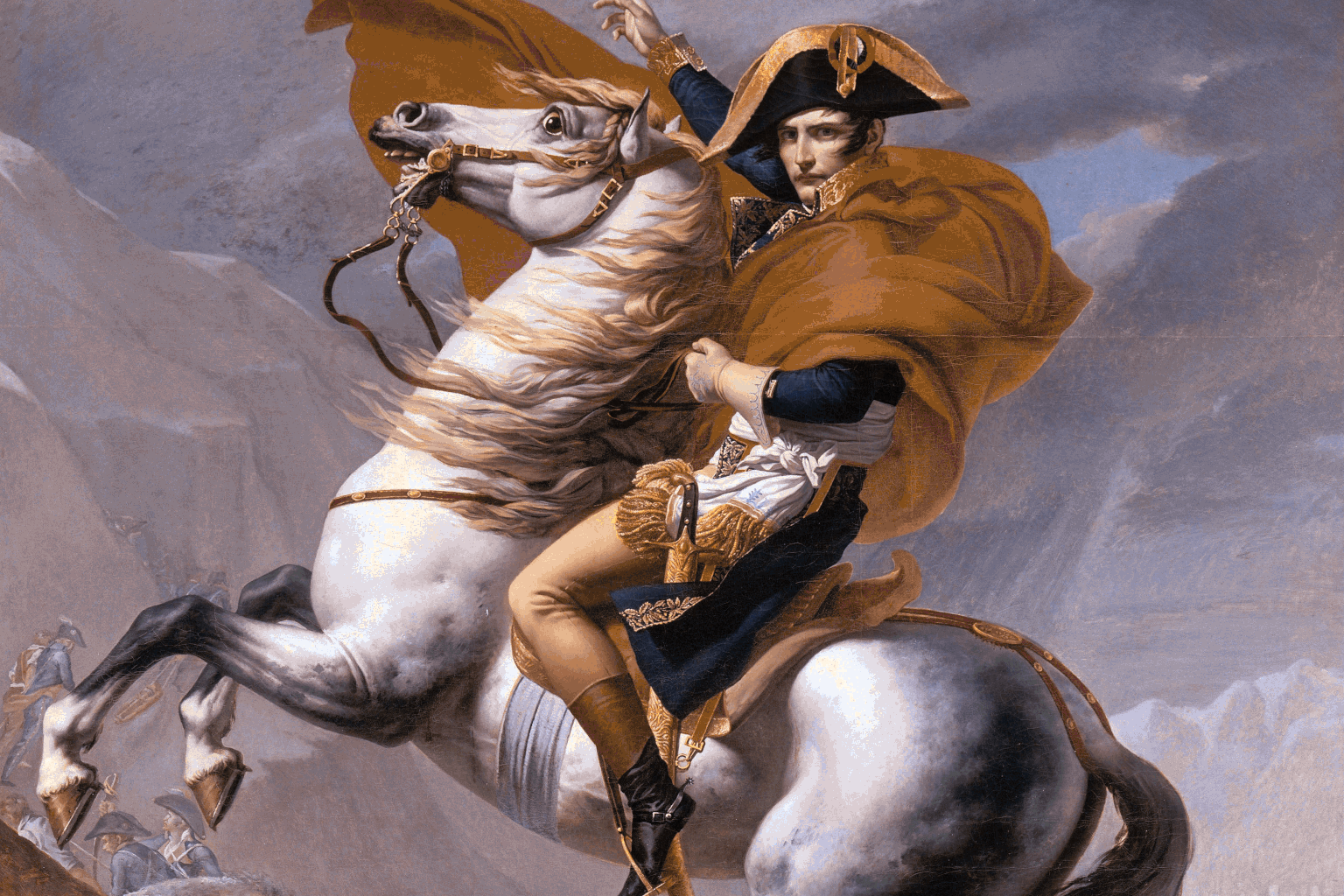
Jacques-Louis David, Napoleon Crossing the Alps, 1802. Oil on canvas. Palace of Versailles. Image credit: Public domain, via Wikimedia Commons.
An art historical painting is a work of art that consciously participates in an ongoing visual conversation across time.
The phrase can easily conjure objects made centuries ago—paintings preserved behind museum glass and reproduced in art history textbooks. But contemporary artists also create paintings with an art-historical consciousness. These works carry an intentional relationship with the vast history of images, materials, symbols, and visual systems that preceded them, extending across cultures.
Artists activate these relationships in many ways.
Structure and Composition
Kehinde Wiley’s monumental portraits place contemporary Black subjects within poses and compositions associated with European traditions of portraiture. His Napoleon Leading the Army over the Alps (2005), for example, draws directly from Jacques-Louis David’s celebrated image of Napoleon crossing the Alps. Wiley places a contemporary Black man within that familiar visual structure. The inherited composition carries associations with authority, heroism, masculinity, and power into another cultural moment.
Here, composition itself carries meaning and art history becomes working material.
Materials Carry Memory
An artist can also enter history through materials and technique. Egg tempera carries centuries of association with panel painting. Gold leaf has a long history in sacred objects, icons, manuscripts, and devotional art. Layered oil glazes connect contemporary painters with techniques refined across generations of workshops and studios.
Faith Ringgold brought several artistic inheritances together through her story quilts, combining painting, fabric, written narrative, family traditions of needlework, African American experience, and sources that included African art and textile traditions. Her works demonstrate how material, storytelling, family knowledge, and art history can occupy the same object.
Visual Traditions Across Cultures
Art-historical consciousness extends far beyond the traditions usually emphasized in surveys of European painting. Artists throughout the world have inherited sophisticated visual systems and passed them forward.
Ethiopian Christian art offers a powerful example. Christianity became established in Ethiopia during the fourth century, and Ethiopian artists developed distinctive traditions surrounding the cross, sacred figures, manuscripts, icons, and religious objects. Certain styles and iconographic conventions developed over centuries and continued to provide models for later artists. The Gondärine tradition that emerged during the seventeenth century, for example, remains influential among painters of Ethiopian religious art.
The same principle can be found across African visual cultures. Pattern, sculpture, textiles, architecture, body decoration, religious objects, and systems of symbols have provided artists with inherited vocabularies capable of being preserved, transformed, combined, and carried into contemporary work.
Africa and Modernism
African art played an important role in the development of early twentieth-century European modernism. Pablo Picasso, Henri Matisse, André Derain, and other European artists encountered African sculpture during a period when they were searching for new approaches to representation. African approaches to the human figure contributed to major developments in the visual language of the European avant-garde. Picasso’s encounters with African sculpture became particularly important during the period surrounding Les Demoiselles d’Avignon and the emergence of Cubism.
This history reveals how complicated artistic inheritance can become. Images and ideas travel between cultures. Artists borrow, reinterpret, misunderstand, preserve, transform, and sometimes appropriate what they encounter. Later generations inherit the results of those exchanges as another layer of art history.
A contemporary African or African-diasporic artist may therefore engage several histories simultaneously: local or ancestral visual traditions, the history of European painting, African influences embedded within European modernism, the histories of colonialism and diaspora, and the artist’s own contemporary experience.
Art history can move in many directions at once.
Portraiture and Representation
Amy Sherald’s portraits participate in another long visual history: the representation of the human figure. Her carefully staged Black American subjects occupy a genre shaped over centuries by ideas about identity, status, beauty, dignity, and social position. Her distinctive grayscale treatment of skin and fields of saturated color establish a contemporary visual language within that inheritance.
Scale, posture, clothing, background, pictorial space, and the direction of a sitter’s gaze all arrive with accumulated cultural associations. Artists inherit these conventions and continue developing them.
History Painting
“History painting,” not to be confused with “art historical painting,” has a specific meaning within Western art history. The term traditionally describes ambitious narrative paintings depicting subjects drawn from religion, mythology, literature, allegory, and historical events. Jacques-Louis David’s The Death of Socrates is a familiar example.
“Art historical” describes something much broader: an artist’s conscious engagement with artistic precedent, keeping previous artistic discoveries, symbols, techniques, and questions active in the present. A painter can reach backward hundreds or thousands of years, draw something forward, transform it through personal experience, and place it into circulation again.
Painting has a memory. Artists inherit that memory from many places and each generation adds something to it before passing it forward.