What is a Religious Painting?
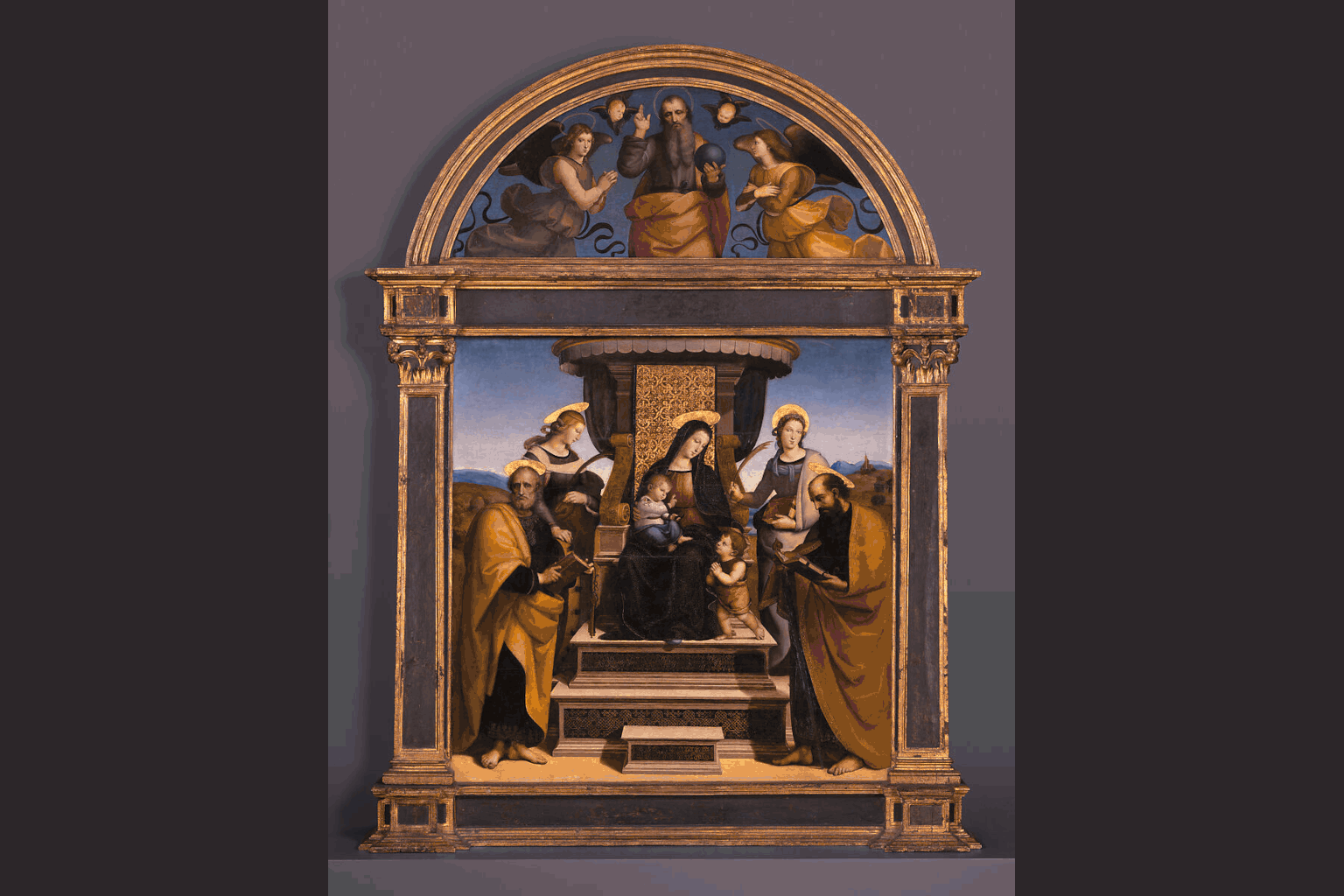
Raphael, Madonna and Child Enthroned with Saints (Colonna Altarpiece), ca. 1504. Originally created for the Franciscan convent of Sant’Antonio in Perugia, Italy. Image credit: The Metropolitan Museum of Art, New York. The Friedsam Collection, Bequest of Michael Friedsam, 1931. Public Domain.
Enter Gallery 609 at the Metropolitan Museum of Art in New York and you can stand before a nearly six-foot-square painting by Raphael. At its center, the Virgin Mary sits upon a throne with the Christ Child on her lap. Saints gather around them. Halos hover above their heads. Gold catches the light. Above the main panel, God the Father appears between angels.
Raphael painted Madonna and Child Enthroned with Saints around 1504 for the Franciscan convent of Sant’Antonio in Perugia, Italy. The painting originally occupied a church, where religious women encountered it as an altarpiece within the rhythms of worship. Five centuries later, it hangs on a museum wall in Manhattan.
This is a religious painting.
Its journey from a Franciscan convent to the Metropolitan Museum gives us a way into a larger question: What makes a painting religious? Its subject provides part of the answer. Its original purpose tells us more.
A religious painting connects the visible world of paint with a system of religious belief. That connection may emerge through a sacred story. It may reside in a symbol or develop through the role a painting plays in worship. In some works, the connection is found in the experience of contemplation itself.
Across centuries and cultures, artists have approached that relationship in remarkably different ways.
Sacred Stories in Paint
One of the oldest roles of religious painting is giving physical form to sacred stories and spiritual ideas which, over time, developed into visual languages that communities learned to read.
European Christian painters made the Virgin Mary one of the most recognizable figures in Western art.
Christian painting also flourished across Africa. Ethiopia, home to one of the world’s oldest continuous Christian traditions, developed a sacred art with an unmistakable visual identity. Figures often confront the viewer with large almond-shaped eyes. Strong patterns organize the surface, and brilliant colors give the images an extraordinary presence.
Along the Nile, medieval Nubian artists transformed cathedral walls into sacred environments. At the Cathedral of Faras in present-day Sudan, images of Christ and the Virgin appeared alongside bishops and rulers. The clothing worn by these figures connected Christian imagery with the society that created it.
Other religions developed their own visual traditions. Hindu painters gave form to stories surrounding deities such as Krishna. Buddhist artists created mandalas that could serve as visual structures for understanding a sacred cosmos.
Painting gave communities a way to make belief visible.
Paintings as Living Instruments
A religious painting could also participate directly in religious life, helping to shape the experience of worship inside a church, providing a focus for prayer, or guiding meditation through a mandala.
In Igbo communities of southeastern Nigeria, Uli painting was part of sacred architecture, connecting flowing designs to ritual life and Igbo cosmology and shaping the way people experienced these spaces.
People encountered painting as part of an overall religious experience unfolding around them.
When a Symbol Carries Centuries
Sometimes an extraordinarily simple form can hold enormous religious meaning.
Consider the Christian cross. At its most basic visual level, it consists of two intersecting lines. Centuries of Christian history have given that geometry profound significance. It has become a form that evokes the Crucifixion and the death of Christ, along with the Christian promise of resurrection.
Forms can direct thought toward the divine. A simple shape can carry an entire history of belief.
What Is a Religious Painting?
The history of religious painting ultimately leads us back to the Met and Raphael’s painting in Gallery 609, where today visitors encounter it within one of the world’s great museums. Five centuries ago, the painting belonged to the religious life of people who gathered before it, bringing their own understanding of its figures and symbols, as well as their faith. That faith is, perhaps, the most critical part of what makes a religious painting.