The Strange and Sacred Labor of James Hampton
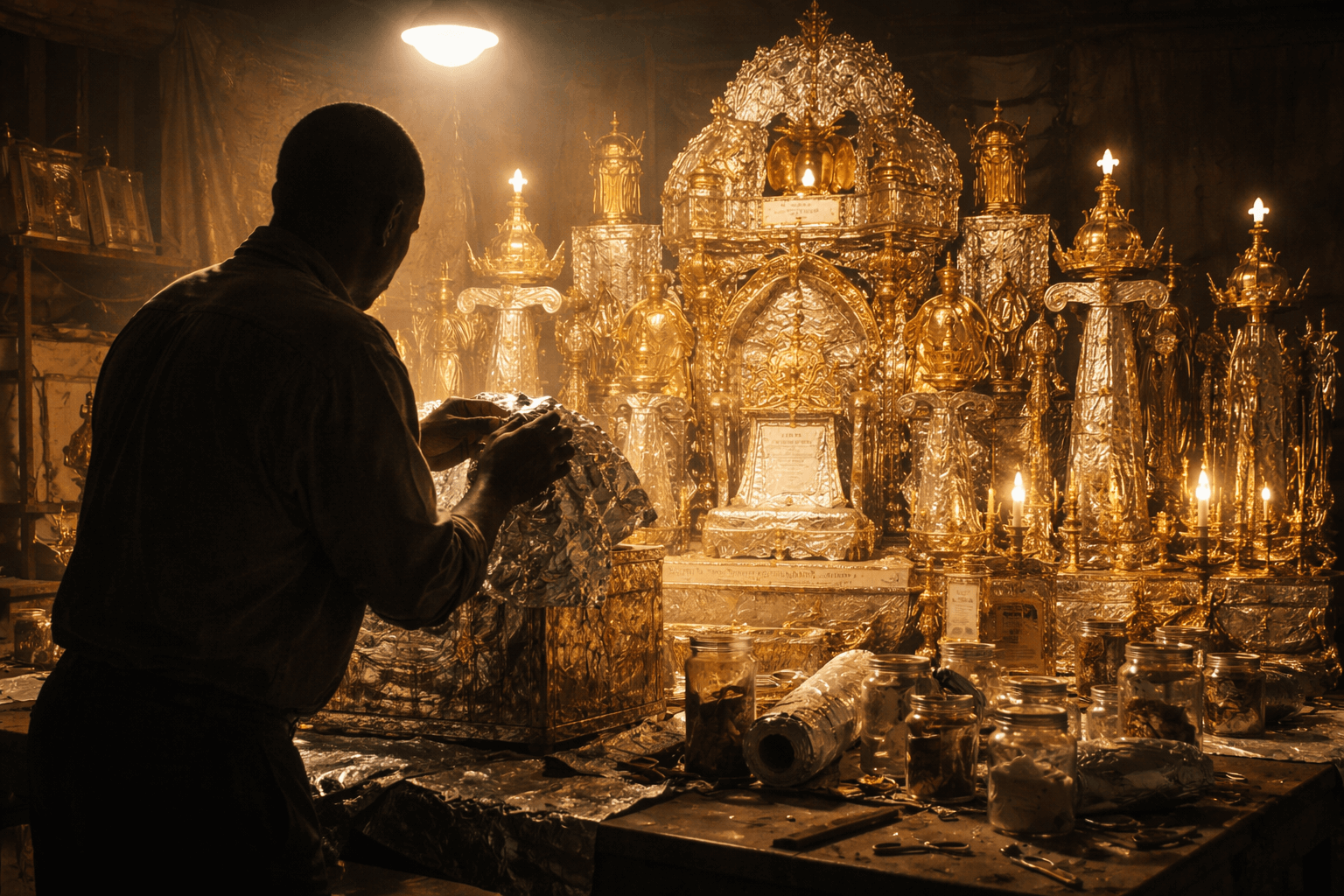
Interpretive rendering inspired by the disciplined construction of James Hampton’s throne.
James Hampton died in 1964 with sixty dollars in the bank. He was a janitor, a veteran, and a bachelor who rented a garage in northwest Washington, D.C. When his landlady entered that garage after his death, she did not find stored tools or forgotten furniture. She found a throne room.
For fourteen years, Hampton had been constructing what he titled The Throne of the Third Heaven of the Nations’ Millennium General Assembly. He built it from discarded furniture, cardboard tubing, desk blotters, jelly jars, light bulbs, and sheets of aluminum foil. He wrapped surfaces in gold and silver foil until they shimmered under even modest light. He arranged chairs in careful ceremonial symmetry, labeled elements with handwritten placards, fashioned crowns, and filled ledgers with notes in a private script that scholars have never fully decoded. The materials were humble, but the ambition was monumental.
Born in 1909 in Elloree, South Carolina, Hampton grew up in a deeply religious environment; his father was a gospel singer and Baptist minister. As a young man, he moved north, served in a segregated Army unit during World War II, and later returned to Washington, where he worked as a janitor for the federal government. On paper, his life appears ordinary, defined by steady employment and modest means. Yet after midnight, when his workday ended, another kind of labor began.
Hampton worked alone in the rented garage, returning night after night to continue construction. He kept detailed records, referred to himself as “Director, Special Projects for the State of Eternity,” and believed he was preparing a monument for the Second Coming of Christ. What he created was neither casual nor chaotic. Though the foil remains wrinkled and the furniture mismatched, the overall structure is rigid and ceremonial. Chairs face a central altar; gold and silver surfaces catch the light; the entire environment feels arranged for an event that has not yet occurred.
Today, the throne resides in the Smithsonian American Art Museum, where it is recognized as one of the most extraordinary works of twentieth-century American art. It was never fully completed. Hampton did not build for critics or collectors. He built because he believed he was called to do so.
Across the history of art, faith has repeatedly demanded material form. Medieval masons raised cathedrals stone by stone, Renaissance painters covered chapel walls with biblical narrative, and ancient sculptors carved gods from rock faces. In each case, belief required physical, repetitive, sustained labor. Hampton belongs in that lineage, even if his marble was cardboard and his gold was aluminum foil.
His story also resonates with a broader Southern Black experience. In communities shaped by segregation, migration, manual labor, and church life, faith has rarely been abstract. It has organized institutions, sustained families, structured hope, and demanded discipline. Devotion has taken visible form—in sanctuaries, in music, in yard shrines, in handwritten sermons, and in objects fashioned from whatever materials were available. Hampton’s garage became one such site of construction.
Not all such monuments survive. Some remain in churches or family homes; others disappear with time. Hampton’s work endured in part because the physical structure remained intact long enough to be recognized. Its survival was fragile.
Preservation, too, is rarely dramatic. It is incremental and often invisible, depending on people who decide, repeatedly, that an object or a story matters enough to protect. Hampton’s throne was built piece by piece after long shifts of unseen labor. Museums are built in much the same way—through collecting, documenting, interpreting, and making history accessible to the public. The work differs in form, but it shares something with Hampton’s midnight construction: patience, repetition, and the conviction that what is being built will outlast the builder.
The throne stands in Washington. The stories preserved here in northeast Louisiana stand for the same reason—because someone believed the work was worth doing.
Often, that work happens after midnight.-