5 Ways African American Creativity Can Shape the Future of AI Art
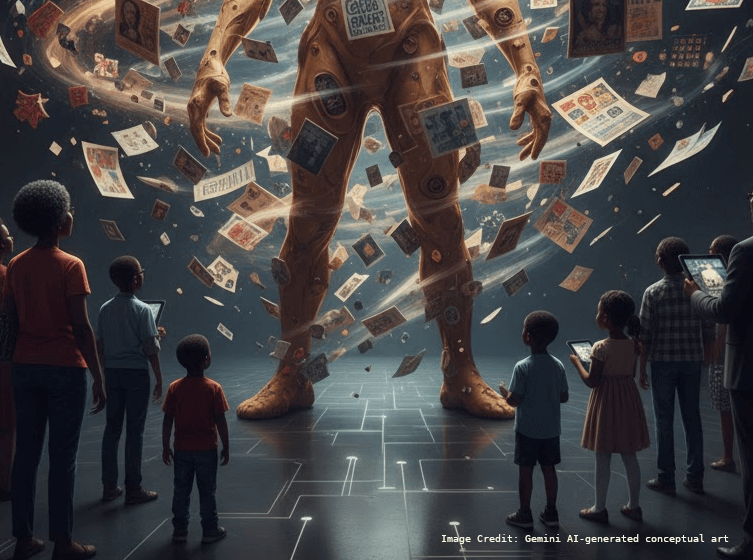
From Galleries to Datasets: Ensuring Our Stories Remain Visible in the Digital Age
If you are an artist wondering whether artificial intelligence will make your skills obsolete — or a parent or grandparent thinking about what happens to your family photographs in a digital future — this conversation is for you. Artificial intelligence is already reshaping how images are created, shared, and valued. The question is not whether AI will influence the future of art. The real question is whether African American creativity will help shape it.
For generations, the fine art world carefully drew boundaries around what counted as “universal” and what was considered “specific.” African American artists were often pushed outside the center of the canon through patterns of structural exclusion. In response, Black artists built movements, archives, and institutions of their own. The Harlem Renaissance reshaped cultural identity. The Black Arts Movement asserted autonomy and demanded space. Community museums like ours emerged to preserve history that might otherwise have been erased.
Today, a new kind of boundary is forming — not in galleries, but in data. Artificial intelligence image generators learn from enormous collections of digital images gathered across the internet. These training datasets influence what the systems interpret as “beautiful,” “professional,” “historical,” or “normal.” Because Western and Eurocentric imagery has been disproportionately represented in online archives and mainstream art history collections, AI systems trained heavily on those sources can reproduce those same imbalances. Researchers studying algorithmic bias have documented racial disparities in machine learning systems — disparities that can flatten or oversimplify African American visual traditions.
If our communities are not present in the digital record, they risk underrepresentation in the systems that increasingly shape visual culture. That reality calls for participation, not fear.
Below are five practical ways African American creativity can shape the future of AI art — starting right here in the Delta.
1. Preserve and Digitize Community Histories
Family photo albums, church programs, quilting traditions, studio portraits, school yearbooks, and community event flyers are more than memories — they are visual records of African American life. As AI systems increasingly rely on digitized imagery to “learn,” communities that do not preserve and digitize their materials risk a quieter form of invisibility.
Preservation, long central to African American cultural life, now carries digital urgency. Public libraries and community colleges in our region often provide scanning access and digital literacy support at little to no cost. Labeling, organizing, and digitizing what already exists is not merely archival work — it is participation in shaping the visual record of the future.
2. Strengthen Artistic Voice and Cultural Literacy
AI tools can generate images quickly, but they do not replace lived experience, cultural memory, or creative perspective. Whether self-taught or formally trained, artists who continue refining their craft ensure that technology amplifies their vision rather than dilutes it. Deep familiarity with African American visual traditions — from local histories to broader diasporic influences — equips artists to guide technology rather than be guided by it.
Cultural literacy becomes a form of creative leverage.
3. Learn How the Tools Work
One does not need to become a software engineer to influence the future of AI art. However, understanding that these systems are trained on data — and that prompts influence results — transforms them from mysterious forces into tools that can be shaped.
Many AI platforms offer limited free access tiers for experimentation. For those without reliable home internet access, local libraries remain essential gateways. Even a basic understanding of how AI systems generate images provides creative agency and reduces intimidation. In many cases, curiosity is enough to begin.
4. Use AI as a Tool for Storytelling and Reimagining
Artificial intelligence can help visualize historical scenes, imagine speculative futures, or prototype ideas that later become physical works in paint, fabric, sculpture, or installation. Used thoughtfully, AI becomes a collaborator rather than a replacement.
The artist remains central, even as the tools evolve. Central does not mean unchanged; it means adaptive. African American creativity has always adapted to new mediums — from spirituals to jazz, from printmaking to photography, from murals to film. AI is another medium, not the end of artistry.
5. Build Intergenerational Dialogue and Community Leadership
Communal memory has long been preserved through story, music, and shared history. In the digital age, we can imagine a new role emerging: the Digital Griot — someone who understands heritage and hardware, story and system, memory and machine.
This future cannot be shaped by one generation alone. Elders carry memory. Young people often carry technological fluency. Both are necessary. Conversations about AI and art belong in classrooms, churches, community centers, and museums. Institutions like ours can help convene these discussions, ensuring that technological change does not outpace cultural reflection.
It is important to acknowledge the barriers. Not everyone has reliable broadband access. Subscription-based AI tools can be costly, and hardware requirements can be limiting. Structural inequities do not disappear simply because new technology emerges. Yet libraries, schools, churches, and museums have long helped bridge gaps in access and opportunity. Collaboration will matter more than individual expertise.
The last century taught us that exclusion can produce cultural innovation. The coming one will test whether artificial intelligence becomes another mechanism of invisibility — or a tool shaped intentionally by diverse communities.
We invite you to share your questions, concerns, or hopes about AI and art. Email us, and we will compile your questions with thoughtful responses for a future post or public discussion.
The future of art will not be determined solely by algorithms. It will be shaped by the communities who choose to engage them. -