History Can Be Nuts: The Truth About George Washington Carver
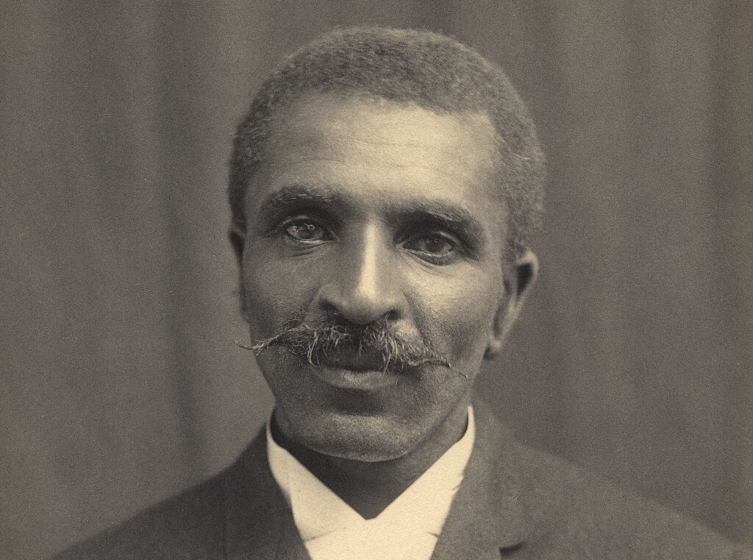
George Washington Carver, circa 1910. Credit: Tuskegee University Archives/Museum. Public domain in the United States (published before January 1, 1931).
For generations, American classrooms taught a simple story: George Washington Carver invented the peanut. It was a tidy narrative—a "Great Man" and his miraculous discovery, packaged neatly between textbook covers.
But the peanut existed for thousands of years before Carver was born, originating in South America and spreading across continents long before his hands touched Southern soil. So what exactly did he do, and why was his actual work—far more radical and consequential—distilled into something small enough to fit inside a children's history book?
These questions lead directly to why the Northeast Louisiana Delta African American Heritage Museum exists.
The Man Behind the Myth
George Washington Carver arrived at Tuskegee Institute in 1896, invited by Booker T. Washington to lead its agricultural program. At that time the rural South—especially the Mississippi Delta region that includes Northeast Louisiana—was trapped in a destructive agricultural system dominated almost entirely by cotton.
For decades farmers had planted cotton year after year on the same fields, exhausting the soil of nitrogen and nutrients. Then a new crisis struck. In the 1890s the boll weevil—an invasive beetle—began spreading across the South, devastating cotton harvests across millions of acres. Entire regional economies built around cotton began to collapse.
For Black farmers and sharecroppers, already trapped in cycles of debt tied to cotton production, survival itself became uncertain. Carver believed the solution lay not in abandoning agriculture, but in transforming it.
A Different Way to Farm
Carver's core idea was simple but revolutionary: rotate crops. Instead of planting cotton year after year, he encouraged farmers to alternate it with crops that restored nutrients to the soil—particularly peanuts, sweet potatoes, and soybeans. These plants replenish nitrogen in depleted ground, gradually restoring soil health.
But Carver understood something equally important. Farmers would not adopt new crops unless those crops could support an economy. So he set out to prove they could.
At Tuskegee, Carver experimented constantly. From peanuts alone he documented more than three hundred potential uses, including dyes, paints, soap, cosmetics, cooking oils, adhesives, and printing ink. From sweet potatoes he developed dozens more applications, including flour, starch, and food products.
Most of these discoveries were not intended to become large-scale industrial products themselves. Their purpose was to demonstrate something powerful: crops long dismissed as marginal could sustain local economies. For farmers dependent on a single vulnerable crop, this knowledge opened a path toward greater independence.
The Classroom on Wheels
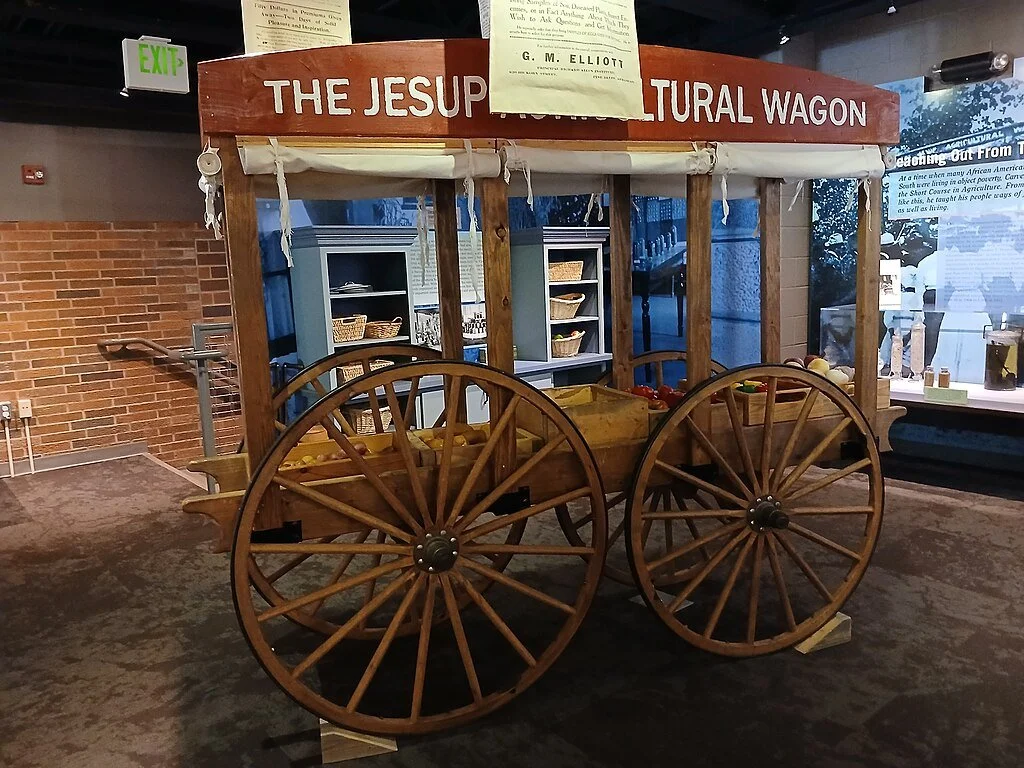
The Jesup Agricultural Wagon on display at George Washington Carver National Monument in Diamond, Missouri. Credit: Photo by Ser Amantio di Nicolao, 2024, via Wikimedia Commons. Licensed under CC BY-SA 4.0 (https://creativecommons.org/licenses/by-sa/4.0/).
Carver also understood that knowledge had to reach the people working the land. In 1906 he helped establish the Jesup Agricultural Wagon—a mobile classroom that traveled through rural communities carrying tools, seeds, and demonstration materials. It allowed Carver and his colleagues to show farmers directly how to compost soil, rotate crops, and diversify production.
In an era before modern agricultural extension programs, the wagon functioned as a moving school for rural farmers—many of them Black families denied access to formal scientific education. Carver's work was not simply about peanuts. It was about putting knowledge in the hands of people who could use it to change their lives.
Why the Story Got Small
So why did the textbooks reduce all of this to a single sentence about inventing the peanut?
Because the real story is harder to contain. A man teaching Black farmers how to rebuild their soil, diversify their crops, and move toward greater economic independence does not fit neatly inside a simplified classroom narrative. A story about scientific curiosity is manageable. A story about agricultural transformation and economic self-determination is not.
The simplified version turned Carver into a harmless inventor. It removed the context that made his work powerful. The why disappeared, leaving only the what.
This is what happens when history is written far from the communities that lived it. Stories are polished until they fit comfortably inside textbooks. Complex struggles become tidy anecdotes. But history is rarely tidy.
The Record Beyond the Textbook
Community institutions exist to preserve the fuller record. When the Northeast Louisiana Delta African American Heritage Museum gathers oral histories, photographs, and community memory, we are not assembling a simplified display. We are preserving the deeper record—the one that resists the smoothing hand of distant committees and textbook summaries.
Within that broader history, Carver is not simply a lone genius holding a peanut. He is part of a much larger continuum: the agricultural knowledge Black people carried from West Africa, the survival strategies developed during enslavement, the post-Emancipation struggle for land and literacy, and the farmers across the Delta who studied new agricultural ideas and adapted them to their own fields.
Carver's bulletins traveled widely throughout the South. Farmers experimented with crop rotation and diversified planting, bringing new scientific ideas into their communities. The work that began in Tuskegee laboratories entered real soil, real farms, and real lives.
An Invitation
When you walk through the Northeast Louisiana Delta African American Heritage Museum, you are part of an ongoing conversation—one that connects discovery, community memory, and the lived experiences of the people who shaped this region. Museums like ours exist because communities choose to protect their own stories.
We invite you to be part of that work. Memberships and donations help us continue preserving the history of Northeast Louisiana and sharing it with future generations.
For more information about supporting us, please visit the museum or contact us directly.