Artist Spotlight: Thelma Golden
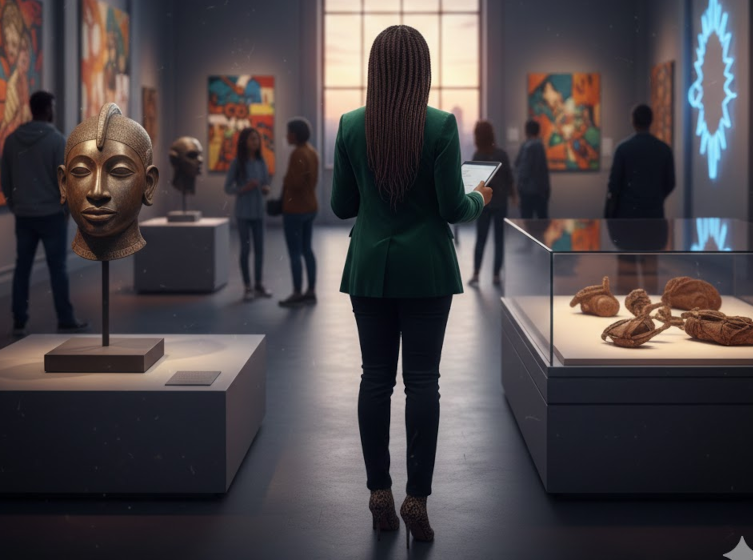
Visualizing the future of curation. Image credit: Gemini AI.
At the Northeast Louisiana Delta African-American Heritage Museum, we understand that the story of art does not live solely on the canvas. It also unfolds through the vision, leadership, and stewardship of those who build the institutions that preserve, interpret, and advance culture. Few figures embody this truth more fully than Thelma Golden.
Though not an artist in the traditional sense, Ms. Golden stands among the most influential creative forces in contemporary art. As Director and Chief Curator of The Studio Museum in Harlem, she has spent decades shaping how artists of African descent are seen, supported, and understood—both in the United States and around the world. Her work demonstrates that curatorial vision can be as transformative as artistic practice itself.
A Career of Groundbreaking Leadership
Ms. Golden’s influence emerged early and decisively.
The Whitney Years
From 1988 to 1998, she served as a curator at the Whitney Museum of American Art, where she organized the landmark 1994 exhibition Black Male: Representations of Masculinity in American Art. At a time when such conversations were rarely centered within major institutions, the exhibition challenged audiences to confront complex narratives surrounding race, identity, and representation. Its impact rippled through the art world, reshaping how museums approached Black subjectivity and contemporary discourse.
The Studio Museum in Harlem
In 2000, Ms. Golden returned to The Studio Museum in Harlem, where she would later become Director and Chief Curator in 2005. Under her leadership, the Museum has grown into the world’s leading institution dedicated to visual art by artists of African descent. It has become both a global cultural authority and a deeply rooted community anchor—an example of how museums can serve their neighborhoods while influencing international conversations.
This dual role resonates strongly with institutions like our own, which balance local responsibility with broader cultural impact.
Reframing Identity: The “Post-Blackness” Conversation
One of Ms. Golden’s most influential contributions came in 2001 with the exhibition Freestyle. The exhibition introduced the concept of “post-blackness,” a term that encouraged artists to reject narrow or prescriptive definitions of Black identity while remaining deeply engaged with Black culture and experience.
Rather than signaling an absence of identity, “post-blackness” opened space for complexity, contradiction, and individuality. The exhibition brought wider attention to a generation of artists who would go on to become leading voices in contemporary art, shaping exhibitions, collections, and conversations for decades to come.
Building Institutions for the Future
Ms. Golden’s impact extends well beyond exhibitions and theory. She has been a driving force behind the Studio Museum’s ambitious effort to construct its first purpose-built home—an investment in permanence, visibility, and long-term cultural stewardship.
This commitment reflects a profound understanding of what institutions represent: not just spaces for display, but foundations for memory, education, and generational continuity. For communities historically excluded from major cultural platforms, such leadership is transformative.
Her contributions have been recognized with numerous honors, including the J. Paul Getty Medal and the Audrey Irmas Award for Curatorial Excellence—acknowledgments of a career that has reshaped the global art landscape.
Shaping How We See
Thelma Golden’s career reminds us that museums do more than preserve history—they actively shape it. Through her curatorial philosophy and institutional leadership, she has helped redefine how art by artists of African descent is framed, valued, and understood.
At the Northeast Louisiana Delta African-American Heritage Museum, we recognize this work as essential. It affirms the importance of strong cultural institutions, thoughtful leadership, and sustained investment in Black creativity—values that resonate deeply within the Delta and beyond.
Get Inspired
We encourage you to explore Thelma Golden’s major exhibitions, including Black Male and Freestyle, and to learn more about the artists whose careers have been shaped through her vision.